


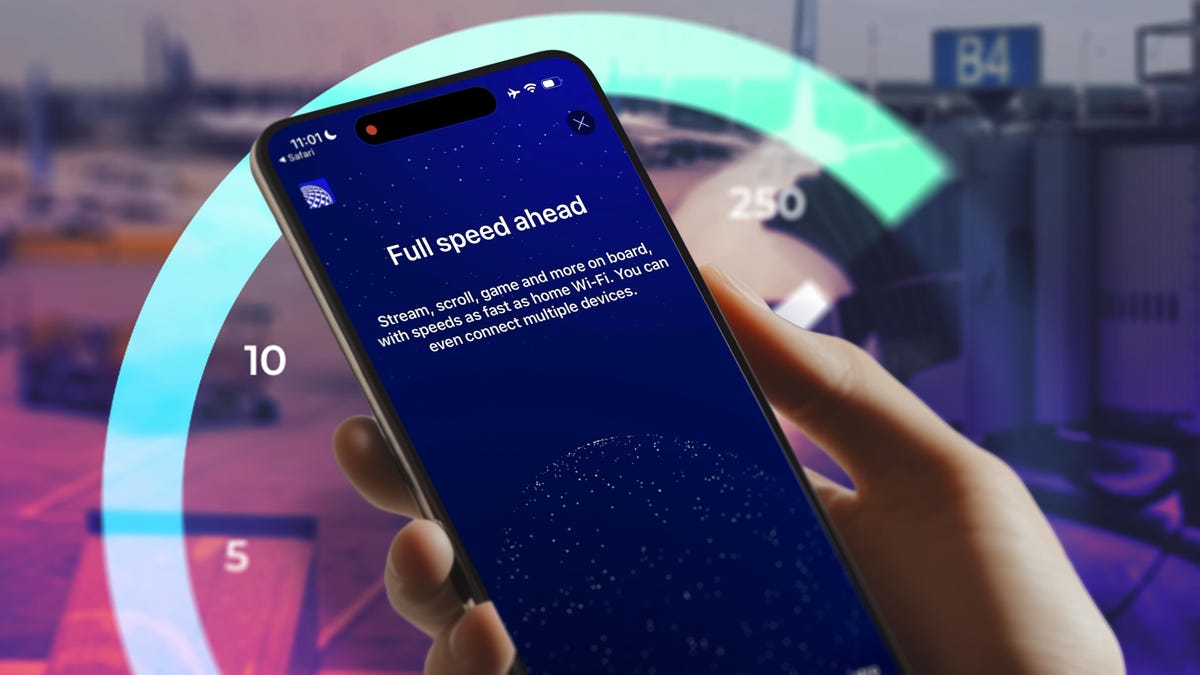
United Airlines is now beginning to offer in-flight Starlink Wi-Fi on its mainline aircraft covering the US and international flights to Canada and Mexico.
It started with a jaunt today that carried a planeload of journalists from Chicago to Milwaukee and back on a demonstration flight. I packed my bag and headed to the Windy City to learn firsthand if the satellite Wi-Fi provider makes a difference.
At a time when our phones and smartwatches have satellite connectivity options — helping us reach emergency responders or send text messages when we’re out of range of a cell signal — Starlink and United are providing travelers with an upgraded convenience. What’s more, we’re getting in-flight Wi-Fi with speeds and connectivity that rival what we experience at home or the office.
Air travel presents a conundrum: If you need Wi-Fi in the air and it’s not working, you’re cooked. There’s no stepping out to a coffee shop hotspot or rebooting your home router. In-flight Wi-Fi has improved over the years, but it still feels risky whether it will work well or at all. And you don’t discover that until you’re already in the air.
The plane I traveled on isn’t the first United aircraft carrying Starlink’s satellite Wi-Fi equipment. United began outfitting many of its regional Embraer E175 jets in March after signing a deal with Starlink’s parent company, SpaceX, last year. Although it’s the inaugural United mainline aircraft, Hawaiian Airlines got the jump late last year when it outfitted its Airbus planes with the technology.
The Boeing 737-800 I flew on goes into active service on Oct. 15, starting with a leg from Houston to Fort Lauderdale. Over the coming months, United expects to outfit approximately 15 mainline Boeing 737-800 planes per month with Starlink antennas.
United is offering Starlink Wi-Fi access free to United MileagePlus members. The Standard Wi-Fi option costs $8 or 1,600 miles for MileagePlus members, or $10 for everybody else. Subscriptions for frequent travelers start at $49 a month (or 7,500 miles).
In-flight Wi-Fi is all about the experience
Believe me, I want to talk about speeds and bandwidth and what a Starlink connection could mean for getting work done or being entertained in the air. But it all starts with getting connected, and too often, that experience sucks.
On my flight from Seattle to Chicago the day before my demo, United’s Standard Wi-Fi took nearly an hour to connect to any of my devices. (United uses different internet providers depending on the aircraft and operating area, and this flight was connected by satellite internet provider ViaSat.) Once the main menu page loaded, selecting most options, including “sign in” and “free messaging,” timed out with an error that there was no network connection.
That cut into my work time, but more importantly, it was incredibly frustrating. Many of us look forward to focused time on a flight to get things done without interruptions, and more frustration is the last thing we want to add to our air travel experience.
This is the first mainline Boeing 737-800 plane outfitted with Starlink in-flight Wi-Fi.
Two experiences stood out when I was on the Starlink-equipped plane. First, it operates gate-to-gate, so you can connect on your phone or tablet (laptops still need to be put away during takeoff) as soon as you get settled in your seat. After we’d landed and were taxiing back to the gate, I forgot that I was still connected through Starlink.
For almost as long as I’ve owned a cellphone, wheels-down meant it’s time to switch off Airplane mode and embrace the familiar connection of local cellular.
Second, the few sign-on steps I had to go through weren’t any more onerous than getting on a public cafe or hotel Wi-Fi network. After connecting to the United Wi-FI network, a portal window opened with a trio of screens explaining how great the new service is (you can skip them) and a field to enter my United MileagePlus account and password.
The process of signing on to the Starlink service involves some marketing you can skip (just don’t skip the ad later).
Oh, and then there’s a video ad, which is 15 seconds or less. (If you’ve been reading so far and thinking, “Wait, it can’t really be free, can it?” there’s your answer.) That ad turns out to be important: You aren’t connected until the video completes.
I was impatient and dismissed the ad on my laptop, which led to some trouble getting connected. Another journalist on the flight mentioned that he encountered the same situation, and the friendly United tech staff on the flight were curious whether the ad had played when they helped me diagnose the issue. I also emptied my browser caches and told the computer to forget the Wi-Fi network, essentially starting me from scratch.
As far as I can tell, no one else on the flight experienced this problem, but it’s safe to say there could still be some prelaunch bugs being worked out. United’s tech support won’t be on hand for regular flights, which is why one of them mentioned they’re trying to iron out any points where flyers might run into difficulty.
Once connected, I could concentrate on trying to use as much bandwidth as possible and look outside occasionally since United scheduled this flight on a beautiful autumn day (instead of bringing everyone to Chicago in the dead of winter).
How Starlink Wi-Fi performed
The hardware that makes this happen is a pair of low-profile 500Mbps antennas mounted on the top of the fuselage. Unlike current units on planes offering standard Wi-Fi, the antennas are essentially exposed to communicate with the network of nearly 8,000 Starlink satellites operating in low Earth orbit (LEO), or about 350 miles in altitude.
To compare, the antenna module on a non-Starlink-equipped United plane parked at the next gate was much larger to shield its antennas, which need to adjust their angles during flight to talk to high-altitude satellites about 22,000 miles up.
The dual Starlink antennas on the United 737-800 are aerodynamic bumps on top of the plane.
In the time it takes a signal to go from a plane to high-altitude satellites, the signal can round-trip the distance between an aircraft and the Starlink satellites 70 times, according to Mara Palcisco, United Airlines vice president of engineering and reliability.
(This is also different from T-Satellite, the Starlink-powered satellite technology offered by T-Mobile. T-Satellite uses a separate collection of satellites to work with phones using a portion of the cellular spectrum.)
What does that mean in terms of the internet experience? Honestly, I’d think I was at home on my high-speed fiber internet if not for the cabin noise and the occasional tight banking turn. I streamed the movie Cowboys & Aliens over Netflix on my iPad, played one of United’s available videos in a window on my MacBook Pro and watched YouTube videos on my iPhone.
Also, because this was a special flight for the press and several United employees, I initiated a video call with two colleagues. Usually, video and voice calls are not allowed — in fact, they’re illegal — and United makes a point of telling customers that they shouldn’t engage in any behavior that disturbs the people around them, including calls, listening to audio without headphones or watching media that would make others uncomfortable. You can watch a live call, but technically not talk on one, and that’s behavior flight attendants will have to enforce.
You need to agree to the rules of good behavior when working with United’s in-flight Wi-Fi.
In this instance, we were encouraged to go ahead, so I had a hard-to-hear video conference with CNET managing editor Patrick Holland and senior reporter David Lumb (maybe it’s time to invest in a pair of AirPods Pro 3). The video quality was stellar — no, I’m not making a Starlink pun, I promise — even better than a few recent calls we’ve had in our respective offices. A FaceTime call with a friend was similar: clear, sharp video with no telltale streaming artifacts.
Video chatting at 35,000 feet with excellent quality over United’s Starlink Wi-Fi. (Warning: Technically illegal.)
But let’s get to numbers. It’s always a nerd joy to go to SpeedTest.net or run the SpeedTest app and be surprised at the numbers it sends back. I consistently got around 250Mbps of download speed and anywhere from 25Mbps to 65Mbps upload speed. I saw that on all of my devices: iPhone 17 Pro, M1 iPad Pro and a 2021 MacBook Pro with an M1 Pro chip.
A sampling of Speedtest readings from a United flight over Starlink Wi-Fi.
To put that into perspective, SpaceX says that Starlink residential internet gets up to 350Mbps download speeds, depending on location. According to an Ookla report, Starlink’s median performance is 105Mbps download, 15Mbps upload and 45ms latency. CNET senior writer Joe Supan saw similar performance when recently testing the Starlink Mini in Washington’s North Cascades mountains. (Disclosure: CNET’s parent company, Ziff Davis, also owns Ookla.)
To make what now looks like an unfair comparison, when I did get United’s standard Wi-Fi access the night before (which I paid $8 for), my speeds were 9.65Mbps down and 1.03Mbps up. Yes, those decimal points are in the correct places.
Streaming video, whether watching in-flight movies, catching up on a series on Netflix or Apple TV or watching live sports, will undoubtedly become more prevalent on flights when this level of bandwidth is available. In fact, when I chatted during the flight with Grant Milstead, United vice president of digital technology, I asked whether the in-flight videos available via United’s portal were cached on a server aboard the plane. (On my flight the previous night, I could view those even when an internet connection was elusive.)
He said that for mainline flights, which carry roughly 170 passengers, the company would still maintain those local servers for redundancy. But the regional Embraer E175 jets, the first of United’s fleet to be outfitted with the Starlink technology, rely on streamed content with no local backup. Given that the video and audio quality, from my perspective, was indistinguishable from broadband at home, that doesn’t come as a surprise.
While waiting for my trip back home (on a plane not equipped with Starlink Wi-Fi), I pondered my lasting impression of this assignment, which had me fly to Chicago, circle above Wisconsin for a couple of hours and then fly back to Seattle.
On my flight with Starlink Wi-Fi, I had uncompromised internet access. I wasn’t thinking about latency, artifacts or whether I was getting my $8 worth. I could work, watch videos, play live video games and just be bothered with any of the usual complications. And that was the best experience.
