


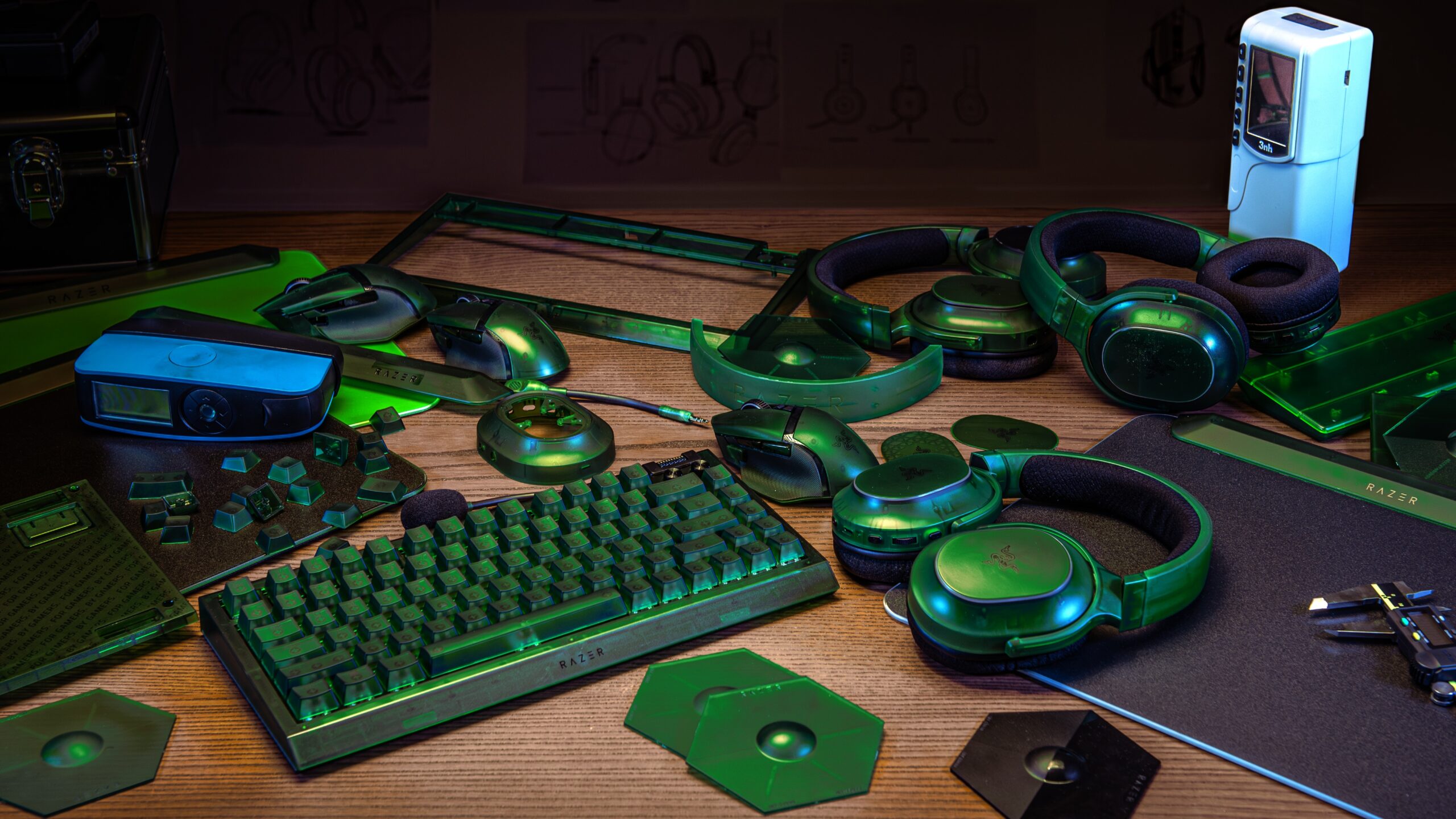
Razer is one of the biggest brands when it comes to gaming, and we see a lot of Razer here at Windows Central. We don’t often get the opportunity to peek behind the curtain, though, and Razer was courteous enough to provide me that chance.
I was given an hour to speak with Charlie Bolton, Razer’s Global Head of Design. Bolton has his hands on every product that comes out of Razer’s labs, and he’s apparently not let outside too often for chats with people like me.
This interview was edited for grammar and clarity. Razer had no input nor saw the contents of this interview prior to publication.
Months of work across multiple teams for each product
“Everything which is Razer, everything you see… the design team has touched in some way,” Bolton told me early in our conversation. Razer has always been a design-focused gaming brand, and product developers, engineers, and designers make up a trifecta that brings every Razer product to life.
It’s a push and pull from every direction. On one hand, even the design team has some leeway to bring their own ideas to the table. “[Product development] understands what’s needed, so even if it’s a crazy idea, we can pitch it out there,” Bolton explained. “Especially in the beginning of a project, we push it a little bit more. You’re not tied down and push the boundaries, and then slowly get pulled back to something more realistic and within the scope.”
Meet Razer’s Global Head of Design

Say hello to Charlie Bolton, the Global Head of Design at Razer for just over five years. With experience designing for Phillips, Huawei, Nokia, and more, Bolton has his hands on practically everything that comes out of Razer in some form or another.
The same is true with the engineering side of things. “We have a lot of say. We’ll push back and say ‘No, no this is not working,'” Bolton said. He used low-profile keyboards, like the Razer BlackWidow V4 Low-Profile HyperSpeed I just reviewed, as an example — if the keyboard internals aren’t sleek enough, the design team can point it out.
“What’s nice about Razer is we really are very careful with the engineering; we almost design products inside out,” Bolton told me, but Razer is all about checks and balances. “There are limits to what we can do for design, so we have to work very closely with the engineers.”
I love learning about the how of making hardware come to life, so I asked Bolton to put the process in his own words.
…we really are very careful with the engineering; we almost design products inside out.
Charlie Bolton, Razer Global Head of Design
“It can take two or three months just to really flesh out what the product’s going to be and how it fits into the bigger picture. … Once that’s done, we can take three months batting around ideas and concepts. … Once that’s agreed, then we start really getting into the design of the product and start really exploring ideas, concepting and many rounds of model making… we need at least three rounds for doing a keyboard or a mouse or a chair, and you have to factor in six or seven months at least.
“We will do in-house 3D prints; we can do that fairly straightforward overnight. We have CAD renderings, we can make it on paper. We can do a nice presentation showing how the design will look, so you’ve got the renders and views of the product, and you have the 3D prints. If that’s generally looking okay, we’ll do a mock-up… which basically look like the real thing. They take about two or three weeks. … That’s before we start going into tooling.
“Once we get the green light, then it will be passed to the supplier and the engineers to actually work out the final engineering parts, do the software, do the circuit boards, everything inside is finally done and that takes another seven or eight months.”
Preserving a legacy while experimenting with design and form

All told, it can easily take 18-24 months from start to finish for a single product to actually reach users. “I’ve been here five years… now doing my sort of second or third round in product families, so I’m really starting to understand all the categories a lot,” Bolton said.
Bolton and I discussed how he works to preserve Razer’s design legacy, especially with long-standing product families like Razer DeathAdder mice and BlackShark headsets that have a strong, outstanding identity.
Everything which is Razer, everything you see… the design team has touched in some way.
Charlie Bolton, Razer Global Head of Design
“We start on the high-end one… then that DNA filters down to the different form factors,” Bolton told me, referencing the recent (and massive) launch of the Razer BlackShark V3 Pro lineup… which I also reviewed.
Sometimes, though, unforeseen circumstances can have an effect on Razer’s design… such as the BlackShark V3 Pro’s new magnetically attached faceplates. “Honestly, the way [BlackShark V3 Pro faceplates] came about were EU regulations that they need to access the battery for recycling,” Bolton explained. “… So, actually, it was a technical reason, but it’s proven to be really interesting because it gives us so many opportunities… without having to change too much, we do can some really creative things.”

I told Bolton I’d love to see Razer embrace the faceplates for user customization, and he wholeheartedly agreed — but nothing is official, yet, so we’ll have to wait and see. Whether that happens or not, though, Razer isn’t just waiting for reasons to change things up, even with its most iconic designs.
“If you get to a V4 or V5, you think… ‘Okay, do we carry on doing this?'” Razer is always experimenting, especially when it comes to design. “We have so many mock-ups and samples where we test out colors, and we do some really interesting things, but it comes down to category management,” Bolton said.
If you get to a V4 or V5, you think… ‘Okay, do we carry on doing this?’
Charlie Bolton, Razer Global Head of Design
“We’re trying to build ecosystems of products. As much as you can do a totally random yellow mouse or purple mouse, or something crazy, we always feel like, ‘Okay, now you need a purple keyboard, you need a purple headset.’ Suddenly, it snowballs into quite a big project,” he continued.
Of course, Razer actually did such an ambitious project not long ago, with the Phantom Green Collection I went hands-on with. “[The Phantom Green Collection] was very hard because we had existing products, and they weren’t technically designed to be transparent. …We had to do a lot of redesigning of the internal structure,” Bolton told me.
Working with the users, not against them

I already mentioned the Razer BlackShark V3 Pro headset, and what surprised me most during my review was how directly Razer addressed all my points of feedback from the last headset. I even joked with the Razer team about it while being briefed on the new headset.
“We listen to the esport players and casual gamers, get their comments — whether it’s from Reddit or all the comments,” Bolton told me. “Feedback is really taken on board, and we try and incorporate that into our designs.”
Going straight to the professionals is especially interesting. Razer definitely isn’t the only brand partnering with esports teams to test, develop, and showcase gaming gear, but the company does take it seriously.
“[Esports athletes] are quite a late stage because they want to test the physical product. … You need working buttons, you need the scroll wheel… we’re testing almost a finished product,” Bolton said. “Occasionally… we’d go to one of the tournaments, and we’d have 3D printed mock-ups, all slightly different ergonomics. … That’s quite early on in the project.”
We try to make the perfect product, but there’s always that room to improve.
Charlie Bolton, Razer Global Head of Design
How late in the development process Razer is able to get a product in the hands of actual players obviously changes how much they’re able to address feedback, of course, but this process does lead to results.
“Some of the Wolverines, we definitely had some feedback which was really good… and we had time to change it and update it,” Bolton shared, mentioning elements like the rear buttons and their placement. “If there are drastic things we cannot do, we won’t just forget it… we will always use it for the next round.”
It’s always interesting to see how different product families evolve over time, especially when you can tell if a company has a realistic culture and actually listens to its users. “There’s always slight limitations on what we can do. We try to make the perfect product, but there’s always that room to improve,” Bolton told me toward the end of our discussion.
I had a blast talking to Charlie Bolton about design at Razer, and it made me more excited to see what the company does next. Speaking of “what’s next,” I also chatted with Bolton about what his (and Razer’s) future may look like.
