


Fall Upgrade Week feels like an odd time to celebrate my move to a 50-year-old film camera, but there’s logic to it: not because film photos are timeless, or because I want to wax lyrical about warmth and grain and analog appeal, but because I don’t think there’s any better way to teach yourself about photography.
That’s how I got into film. At some point over the last decade, reviewing phones morphed more or less into reviewing cameras with touchscreens on the back. For a writer with no photography experience, that started to become a problem, and I realized that I needed to learn enough about cameras to hold my own. I was having to take my own product photos, too, so I needed to get better at the practical side of photography, not just the theory.
I started by borrowing an old DSLR from my office’s photography studio, using it for work photos and the odd bit of weekend practice. I tried to make myself think about framing, to consider camera modes, to learn how to take advantage of light. It helped, but only to a point. The problem with modern cameras, you see, is that everything can be made automatic. And sure, I started out doing things as manually as I could, but for obvious reasons, most of my photos sucked. When I switched the camera to its automatic mode, they sucked a whole lot less. Simply having the option to let the camera do the work meant that I inevitably did let the camera do the work, and I wasn’t learning much as a result.
Clearly, I needed a camera that could do less, not more. But cameras don’t come cheap, either — certainly not cheap enough for an entry-level journalist’s salary. Basic tech at a budget price? It had to be a film camera.


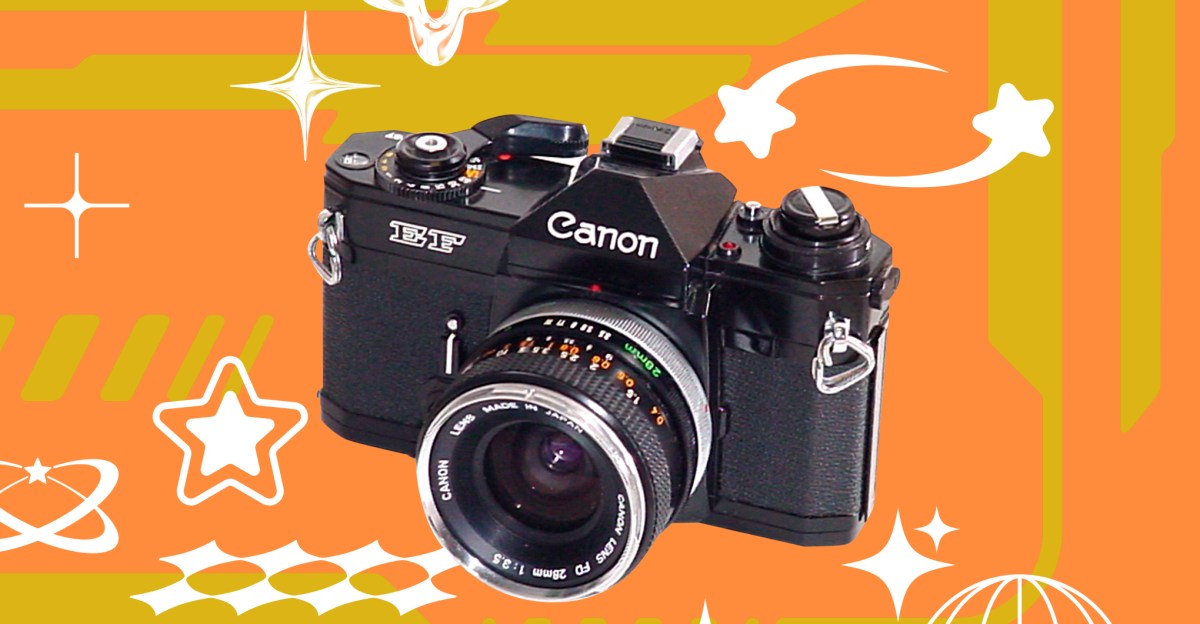
I turned to eBay, and for the princely sum of £129.01 (about $166 at the time, if I did my math right), I became the proud owner of a Canon EF SLR with a 50mm, f/1.8 lens and an original strap that was about ready to snap (and eventually did, prompting me to spend more than I probably should have on a replacement from Peak Design).
Manufactured between 1973 and 1978, the Canon is comfortably older than me, but probably in better condition. It’s picked up a few dents and scratches over the years — some before I got my hands on it, plenty from after — but given it’s built of metal and has the weight and heft of a brick, I’m confident it’ll outlast me.
Most importantly, it’s basic. Real basic. This was just about top-of-the-line tech in the mid ‘70s, which means it has nifty features like an electro-mechanical shutter that only uses battery for exposures longer than half a second, but is entirely mechanical below that. But the most automated it gets is a shutter priority mode, meaning you pick the shutter speed and the camera automatically sets aperture. I used this for a bit, just to get to grips with things. Picking your shutter speed still means factoring in how light or dark your environment is, or how fast-moving your subject is, so there’s none of the set-and-forget approach that a modern camera allows for.


It didn’t take me long to realize that by setting shutter speed I was also thinking about aperture. Opting for a fast shutter speed made the camera more likely to use a wider aperture to compensate, resulting in a more shallow depth of field; a slower shutter speed tended to leave more of the photo in focus. And if I was already worrying about aperture… well, it made no sense to use that auto mode. I switched to manual shooting and haven’t looked back, trusting the built-in light meter to give me a rough guide to the aperture, and my instincts to take it from there.
Since then I’ve slowly begun to think more about the film itself, using different ISOs depending on the light, or trying (and mostly failing) to capture great shots in black and white.
I should be clear: I have taken a lot of bad film photos over the past six years. And that sucks! Not least because while film cameras are cheap, film isn’t always. I might well have spent more on film rolls and development than I ever would have on a modern mirrorless and a lens or two, but that’s part of the point too: film shots matter, so you never want to waste them.
1/35
Hand me a digital camera (or a phone) and I’ll take 10, 20, 30 shots of the exact same thing in the hopes that one of them comes out right. I’ll shoot hundreds of product shots for a Verge review, or of a dinner out for my food newsletter, confident that I can brute force my way into winning a numbers game. Sure, I think about framing, factor in where the light’s coming from or what’s the best angle. But any single photo doesn’t really matter, encouraging me to shoot lots and think little.
The sheer cost of film — and the inconvenience that comes with a single roll of 24 or 36 photos that you’ll have to swap at some point — changes the equation entirely. I buy the cheapest color film I can find, and still pay around £10 (about $13.50) per roll. Then I pay another £6 (or $8) to get it developed and scanned into JPEGs. That means I’m paying about 60 cents total per photo, and that’s as cheap as I can get it — I’d have to pay more for fancier film, higher resolution scans or RAW files, and to get physical prints. I don’t want to waste a single frame if I can help it, so every photo is considered, calculated, obsessed over. I can’t get away with glossing over settings or trust that I’ll fix the framing in post, meaning that the essential trio of ISO, aperture, and shutter speed is never far from my mind.

On the other hand, while film itself is an added cost, the lenses are a lot cheaper. I’ve got a collection of four lenses now, and the most expensive of the bunch was £33.95 (about $41 at the time) for a 28mm wide-angle from US manufacturer Bell & Howell. I spent a few quid less than that on a 70-210mm variable telephoto which I took with me on a safari on Kenya — Canon’s cheapest modern equivalent to that telephoto would be 10 times the price, and you could pay 10 times that again if you wanted to. It’s how I’ve learned too — for about $100 total I picked up a trio of new lenses that have each taught me more about aperture, framing, and depth of field, things I could never have learned with the same old 50mm that I picked up on day one.
There are downsides. I’ve already said film can get expensive, and I nearly quit entirely at the height of the covid pandemic when worldwide shortages spiked prices even further. I’ve lost countless shots to light leakage or accidental mishandling, plenty have come out distorted or discolored, and at least two entire rolls have been essentially wasted because they were exposed to light. I miss the immediacy too — by the time I finish shooting a roll it’ll be at least a week before I get my photos back, and usually longer. That can mean wonderful surprises when I discover a shot I’d entirely forgotten, but it can equally dampen the educational aspect — if I can’t remember taking the shot, I sure as hell won’t remember what settings I used to get it, or how to do the same in the future.
I still want a digital camera. I read my Verge colleagues’ camera reviews enviously, tempted by the siren song of modern processing, immediate access, and that easy Auto mode I’ve so long denied myself. A few times a year I’ll find myself Googling second-hand Fujifilms just to toy with the idea. I’m sure I’ll buy one eventually, but thanks to film I know I’ll be all the better a photographer by the time I do. And either way, my trusty old Canon EF isn’t going anywhere.
Photography by Dominic Preston / The Verge
0 Comments
