


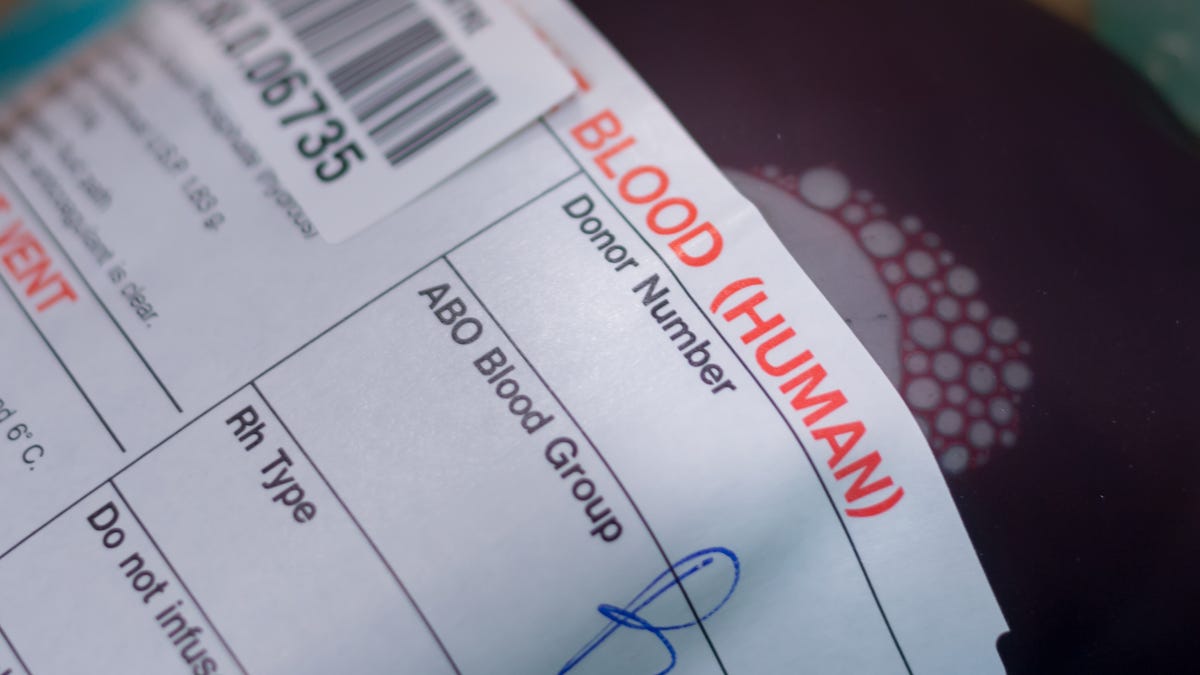
Knowing your blood type is crucial medical information, but unless you’ve given blood before you might not be sure what yours is. I realized this when I was asked for mine while filling out paperwork to be a volunteer at a children’s hospital. I wasn’t 100% positive what mine was, and after looking through my medical paperwork I couldn’t find it there either. This led me to an important question: How do you find out what your blood type is?
Knowing your blood type is important because it can tell you about how at risk you are for certain conditions, and can be especially important information to have in a medical emergency. Fortunately, there are ways to find out that are quick, easy and even free.
Don’t miss any of our unbiased tech content and lab-based reviews. Add CNET as a preferred Google source.
What are the different blood types?
Blood type is categorized into one of these eight groups: A-positive, A-negative, B-positive, B-negative, O-positive, O-negative, AB-positive and AB-negative. But what determines blood type and what does that blood type mean?
Blood types are determined by antigens — a substance that triggers an immune response — on the surface of red blood cells. There are ABO antigens, which designate ABO blood types. This is determined by the ABO gene. For example:
- Type A blood type has the A antigen
- Type B blood type has the B antigen
- Type AB blood type has both the A and B antigen
- Type O doesn’t produce any A or B antigen
There are also Rhesus (Rh) antigens, which determine if blood is “positive” or “negative.”
If you have Rh proteins on the surface of your red blood cells, you are Rh positive (like me and about 80% of the population). If you don’t have Rh proteins on the surface of your red blood cells, you have negative blood.
Blood type is categorized into one of these eight groups: A-positive, A-negative, B-positive, B-negative, O-positive, O-negative, AB-positive and AB-negative.
How to find your blood type
Here’s three main ways to type your blood:
- Have your doctor do a blood test
- Donate blood
- Use an at-home blood test
1. Clinical test
One of the easiest and most effective ways to determine your blood type is to have your doctor perform a test. A professional will draw blood and then perform two tests on the blood sample: forward typing and reverse typing.
During forward typing, the blood sample is mixed with antibodies against type A and B blood. Based on whether the blood cells stick together when mixed with the antibodies, your blood type can be determined from there. If your blood cells stick together when mixed with antibodies against type B blood, you have type B blood. If your blood cells stick together when mixed with antibodies against type A blood, you have type A blood.
To confirm the result, the next step is reverse typing, meaning the blood sample without red blood cells — called a serum — is mixed with type A and type B blood cells. Type A blood will have antibodies against Type B blood in the sample and type B blood will have antibodies against Type A blood. Type O blood will contain antibodies against Type A and Type B. So, if sticking occurs when the serum is mixed with type B blood cells, you have type A blood, and if sticking occurs when the serum is mixed with type A blood cells, you have type B blood.
I recommend calling your doctor’s office to see what a blood type test costs out-of-pocket and if it’s covered by insurance.
2. Donate blood
This is an easy — and free — way to determine blood type, but results are not immediate.
If you donate to a blood drive, you can simply ask the staff about your blood type. Blood usually is not tested right away, so it may take up to a few weeks to get the results.
With at-home kits, you can determine your blood type in just a few minutes.
3. At-home blood test
At-home tests are relatively straightforward. You will usually start by wiping your finger with an alcohol wipe and then be required to prick your finger with a disposable lancet to draw blood. Then, you will wipe blood on the provided card. Depending on how the blood dries, clumps or spreads, you will be able to compare your blood stain to a results card. Within minutes, you’ll be able to determine your blood type.
