


When you crack open your mailbox, it’s almost as if your letters just appear. Long before the days of speedy, overnight mail deliveries, postal service workers meticulously sorted through letters by hand and transported mail on horseback. For more than 250 years, the US Postal Service has worked behind the scenes to build a faster delivery network, and this mission has quietly pushed it to the forefront of technology.
“Most people treat the Postal Service like a black box,” USPS spokesperson Jim McKean tells The Verge. “You take your letter, you put it in a mailbox, and then it shows up somewhere in a couple of days. The truth is that that piece of mail gets touched by a lot of people and machines and transported in that period of time — it’s a modern marvel.”
One of its big breakthroughs took place in 1918 with the introduction of airmail. The USPS worked with the Army Signal Corps to use leftover World War I aircraft to launch the service, and the planes were as barebones as they could get. An excerpt from a 1968 issue of Postal Life called the early aircraft “a nervous collection of whistling wires” with “linen stretched over wooden ribs, all attached to a wheezy, water-cooled engine.”
At the time, pilots literally risked their lives delivering mail — 34 of them died between 1918 and 1927. “There was no commercial aviation, no airports. There was no radio. There was no navigation,” USPS historian Stephen Kochersperger says. “The Postal Service had to develop all of those things just for getting the mail delivered.”
Once the USPS established that it could reliably deliver mail by plane, Congress allowed it to contract airmail service to commercial aviation companies, laying the groundwork for the major airlines that we know today, like American Airlines and United Airlines. Along with getting paid for delivering mail, contractors found that they could make even more money by carrying passengers with their cargo. “That was where commercial aviation took off,” Kochersperger says.
Airmail routes gradually began to expand internationally, first to Canada and then to Cuba. But a couple decades later, the USPS experimented with a novel form of delivery: mail-by-missile. In 1959, the USPS and the US Navy loaded a Regulus I missile with two mail containers that had 3,000 letters in total. The missile traveled 100 miles in around 23 minutes, successfully landing at a Navy base in Mayport, Florida, with the help of a parachute. Despite its success, the idea never took off. It turns out missiles just can’t carry that much mail. And overall, this rather ridiculous demonstration was more of a stunt to show force during the Cold War, according to the Smithsonian.

Back on the ground, the USPS set its sights on improving the speed of mail processing. Though it began experimenting with a mail canceling machine in the 1920s, which put a mark on used postage, it wasn’t until the 1950s that it deployed an electromechanical sorting machine. Instead of manually sorting mail using the “pigeonhole” method, in which workers would insert pieces of mail into different compartments inside the post office depending on the address, the machine could do that for them.
“The Postal Service is a driver of technological change.”
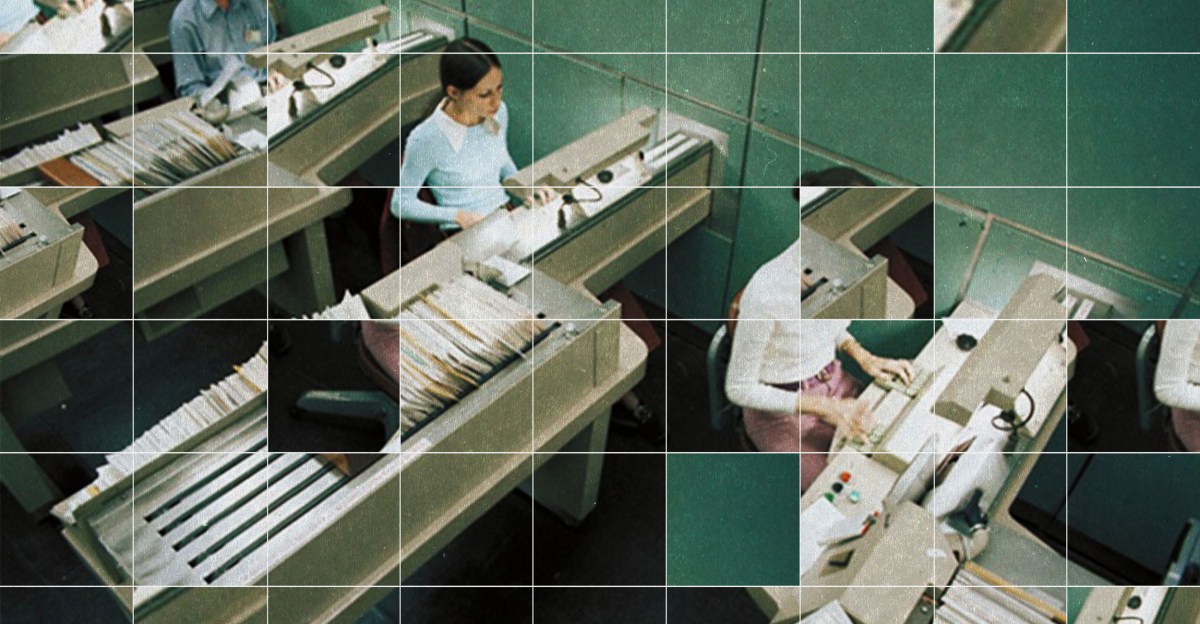
The Transorma multi-position letter sorting machine measured 13 feet high and was split across two levels. It carried mail on a conveyor belt from its lower level to a group of five postal workers at the upper level. The clerks would then use a keyboard to enter information about their destination. Based on the inputted information, the machine would then transport letters to different trays and drop them into chutes that brought them back to the lower level. But as the volume of mail increased in the years after World War II — going from 33 billion pieces of mail per year to 66.5 billion between 1943 and 1962 — the USPS needed a way to keep up.
For years, the USPS had depended on clerks to memorize dozens of delivery schemes that they would use to sort letters, preparing them for carriers to distribute throughout town. “That changed dramatically in 1963, [with] probably the biggest innovation the Postal Service has ever rolled out, called the ZIP code,” Kochersperger says. “For the first time, mailing lists could be digitized in computers and sorted in new ways.”
The ZIP code — short for Zone Improvement Plan — uses its first digit to indicate which region of the US a parcel is headed, the second and third to signal a nearby major city, and the final two to indicate a specific delivery area. The pace of innovation at the USPS ramped up following the introduction of the ZIP code, with many subsequent innovations building on its foundation.

That includes the USPS’s adoption of optical character recognition (OCR), a widely used technology that converts written or printed words into machine-readable text. In 1965, the USPS began to send large volumes of mail through OCR machines, allowing a “digital eye” to recognize addresses and automatically sort letters. If the machine couldn’t make out a person’s handwriting, the USPS would send an image to a remote encoding center (REC) for human review.
At one point, the USPS had as many as 55 RECs, but now only one remains in Salt Lake City, Utah. “As our computer systems have gotten better at recognizing handwriting, we’ve gotten to the point where it’s significantly reduced the number of letters that have to go to remote coding,” McKean says. Today, the USPS’s OCR technology can read handwritten mail at nearly 98 percent accuracy, while machine-printed addresses bump its accuracy to 99.5 percent.
That’s thanks to advances in machine learning, which the USPS, too, has been using in the background for more than 20 years; it first started using a handwriting recognition tool in 1999. The USPS is currently in the middle of a 10-year modernization plan, which includes investments in technology, such as AI. However, the plan has faced criticism for raising the price of stamps and causing service disruptions in some areas.
“The Postal Service is a driver of technological change,” McKean says. “It’s hard to overstate the amount of technology that the Postal Service has been involved in either popularizing or innovating over the last 250 years.”
