


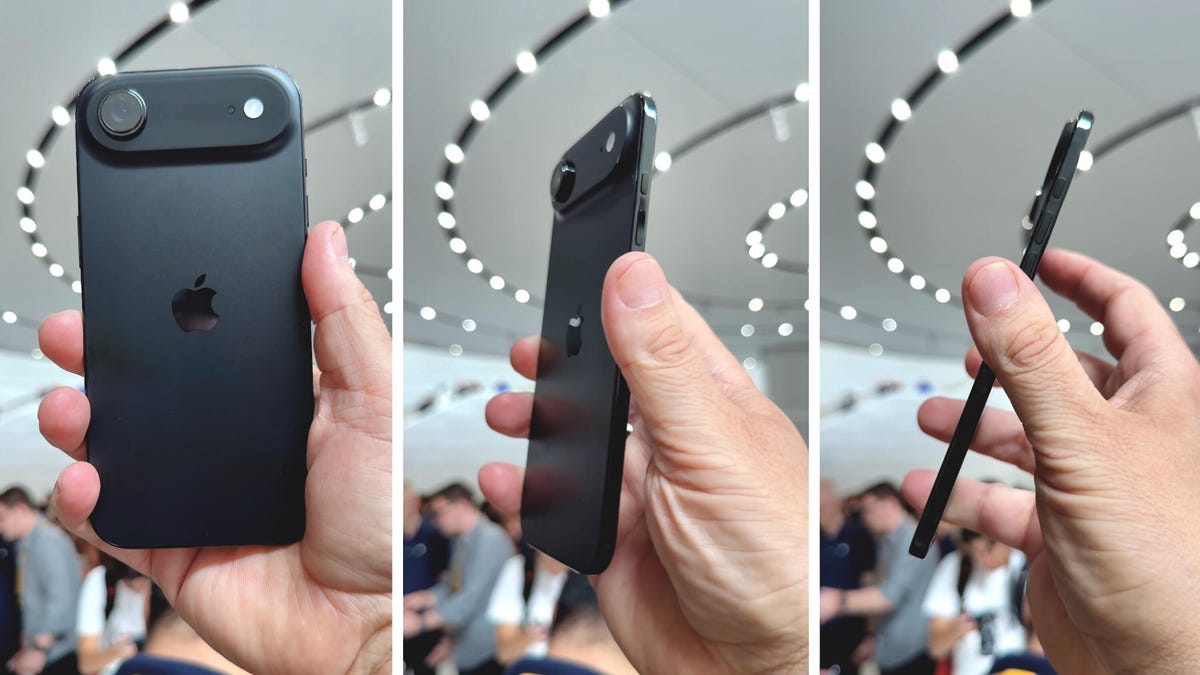
The biggest announcement coming out of the iPhone 17 series’ launch event earlier this week wasn’t about the most powerful iPhone yet — it was for the thinnest. At 5.6mm, or less than a quarter of an inch, the iPhone Air stole the show. And even though it was far from the first mainstream “thin phone,” it may just kick off the trend in a major way in the years to come.
There’s a long-running sentiment in the mobile industry around Apple’s impact on phone trends: Once the iPhone-maker makes a strong design choice, other companies follow. That was true in 2007 when the company debuted the original iPhone (and others followed the front glass touchscreen design), true when the iPad debuted to popularize the tablet format and was sadly true when it got rid of the headphone jack.
So the big question is: Will the iPhone Air make thin phones mainstream? Probably not, says CNET Senior Technology Reporter Abrar Al-Heeti, who was on the ground at Apple headquarters for the launch event and got hands-on time with the new, skinny iPhone. But now, the thin phone niche is being reinforced by a brand with some of the most loyal fans.
“Apple isn’t necessarily setting a trend with the iPhone Air, since so many phone manufacturers have already developed thin phones,” Al-Heeti said. “But it may have legitimized the form factor among people who have wanted a thin phone and sworn allegiance to Apple’s products.”
Don’t miss any of our unbiased tech content and lab-based reviews. Add CNET as a preferred Google source.
There are a couple reasons Apple would make a thin iPhone. The most obvious: The company believes consumers want one. It wouldn’t be alone in that thinking, as Samsung debuted its Galaxy S25 Edge earlier this year. We’re still waiting for official sales tallies to see if buyers were eager to opt for a 5.8mm phone over its 7.2mm and thicker S25 series siblings. Leaked info suggests sales were underwhelming, according to The Elec, but Al-Heeti found that, “I’ve grown so used to its thin, lightweight design that holding any other phone feels like a drag.”
The iPhone Air is the biggest redesign to the iPhone in some time, and judging by the X-ray cutaways of the new device during the launch event, Apple has performed some technical wizardry in cramming nearly all the chips and hardware into the top of the phone to achieve its 5.6mm profile. Aesthetically, it’s a new page in the company’s product book, a way for Apple to appeal to another subsegment of customers, said Nabila Popal, senior director of the International Data Corporation’s data and analytics team.
“The iPhone Air is Apple’s thinnest phone ever and its boldest design move since the iPhone X,” Popal said. “It will draw in users who love leek aesthetics, while the Pro lineup takes the crown for majority of users prioritizing battery and camera performance.”
Analysts I spoke to agreed that the iPhone Air serves a few purposes, from replacing the iPhone 16 Plus with a more premium choice in Apple’s lineup to serving as a showcase device for the company’s emerging technologies (like its in-house C1X modem and N1 connectivity chip). But they also pushed back on the idea that the iPhone Air would open the floodgates for thinner phones.
“I think we knew thin and light phones were going to be coming regardless of Apple’s launch,” said Anshel Sag, principal analyst at Moor Insights and Strategy.
What role does the iPhone Air play?
Thus far, the iPhone Air and Galaxy S25 Edge have both been slotted into the middle of their lineups, offering an aesthetic choice that nevertheless had slight specs upgrades over their standard iPhone 17 and Galaxy S25 siblings, respectively. They are the novelties in the middle of more-of-the-same, and perhaps arrive at the right time amid not much other innovation.
This iPhone generation is less about introducing breakthrough specs and more about cleverly rearranging the price bands and distinguishing the design differences at each tier, said Counterpoint Research Associate Director David Naranjo.
“The iPhone Air is the wild card — if it resonates, Apple widens the premium middle and lifts the margin mix without needing a Pro-class camera across the board,” Naranjo said.
The Samsung Galaxy S25 Edge, another incredibly thin phone.
That single 48-megapixel camera on the back of the iPhone Air is its biggest obvious deficiency. (We’ll wait for our full review to see how other factors like its battery life and performance measure up.) At $999 to start, it has a similar solo camera setup as the $599 iPhone 16E. Even the Galaxy S25 Edge managed to retain an ultrawide rear camera. Clearly, there’s a price to pay for going thin.
“I just think that this first generation of really thin phones make lots of compromises, whether it’s on battery capacity or camera configuration that I hope will be resolved with time,” Sag said. “Much like we’ve seen on foldables.”
Sag is bullish that the Air will sell exceptionally well, and believes that its camera and battery capabilities will improve with time. In some ways, it still is a first-generation device, and later years’ Air devices may manage to cram in more cameras and battery capacity.
Apple is running into the same design constraints as other phone-makers who have attempted to make thin handsets in the past, pointed out Avi Greengart, president and lead analyst at Techspontential. He pointed to the modular Motorola Moto Z that launched in 2016, which was 5.2mm thick on its own but needed its magnetic battery accessory clipped to the back that added bulk: “Without that accessory, the Moto Z was too compromised, and it didn’t sell well,” Greengart said.
Apple’s selling a MagSafe battery accessory for the iPhone Air.
Battery life has been the chief concern for thin phones. Losing space inside a phone means something has to give, and that’s assumed to have been battery capacity. Though they have the same size screen, the Galaxy S25 Plus has a 4,900 mAh battery while the thin Galaxy S25 Edge’s is 3,900 mAh. For its part, Apple doesn’t share specifics on capacity. But during the iPhone 17 launch event, the company promised the iPhone Air would have all-day battery life… and then immediately introduced a MagSafe charging pack. That got a laugh out of the attending press in the audience.
Whether or not the iPhone Air sells at mass volumes, it does open up opportunities for Apple — not just for a new customer subset, but for whatever Apple might be working on. IDC’s Popal explicitly noted that the thinner phone’s design paves “the road to a foldable iPhone possibly next year.” She’s not alone in thinking so.
“I think a lot of these thin phones are much more an engineering exercise to enable better foldables,” said Sag.
Does the iPhone Air lay groundwork for the iPhone Flip?
Apple has reportedly been working on a foldable iPhone, sometimes referred to as the iPhone Flip, since potentially before the COVID-19 pandemic started in 2020. While the first foldable phones debuted that year from Samsung and Motorola, they were in rough shape, but subsequent iterations over the years increased their durability and features. While leaks and rumors suggest Apple has been working toward its own folding device, some of those early reports claim the inability to reduce the on-screen crease, where it folds, has delayed its release.
The iPhone Air as seen from the side. Note the enlarged camera bump, where most of the the phone’s hardware is located.
Screen tech aside, the iPhone Air does seem like a stepping stone to an iPhone Flip, which is rumored to be a clamshell foldable like the Samsung Galaxy Z Flip 7. Relocating most of the hardware to the top half of the new iPhone is something that appears to be the popular way for companies to lay out the internals of their clamshell foldables — just look at iFixit’s Z Flip 6 teardown, where the bottom half of the device is essentially just the larger battery pack (a smaller one is paired with the chips and most hardware in the top half).
Getting the iPhone Air down to 5.6mm thick is also important for making sure a folded-up iPhone Flip isn’t too bulky. Recent book-style foldables released this year have been thinner than ever: The Samsung Galaxy Z Fold 7 is only 8.9mm when folded shut (or 4.2mm when unfolded), while the Oppo Find N5 is roughly identical at 8.93mm thick when folded (or 4.21mm when unfolded flat). Even the Google Pixel 10 Pro Fold isn’t much thicker at 10.8mm when folded closed (or 5.2mm when unfolded).
Thus, Apple has good reason to trim away at the thickness of its iPhones, even if sales don’t take off for this first generation of the iPhone Air. But beyond making a marketable product out of R&D milestones, it’s also an experiment, of sorts, to see if consumers will be entranced enough by thinness alone.
“Apple is betting that advanced materials, eSIM, and more efficient silicon now enable a smartphone experience good enough to allow consumers’ emotional decision making to take over,” Techsponential’s Greengart said. “Super-thin, super-dense phones like the iPhone Air and Samsung Galaxy S25 Edge feel extremely nice.”
