
Close Menu
TechUpdateAlert

    Subscribe to Updates

    Get the latest creative news from FooBar about art, design and business.

    What's Hot

    My Health Anxiety Means I Won’t Use Apple’s or Samsung’s Smartwatches. Here’s Why

    December 22, 2025

    You can now buy the OnePlus 15 in the US and score free earbuds if you hurry

    December 22, 2025

    Today’s NYT Connections: Sports Edition Hints, Answers for Dec. 22 #455

    December 22, 2025
    Facebook X (Twitter) Instagram
    Trending
    • My Health Anxiety Means I Won’t Use Apple’s or Samsung’s Smartwatches. Here’s Why
    • You can now buy the OnePlus 15 in the US and score free earbuds if you hurry
    • Today’s NYT Connections: Sports Edition Hints, Answers for Dec. 22 #455
    • Android might finally stop making you tap twice for Wi-Fi
    • Today’s NYT Mini Crossword Answers for Dec. 22
    • Waymo’s robotaxis didn’t know what to do when a city’s traffic lights failed
    • Today’s NYT Wordle Hints, Answer and Help for Dec. 22 #1647
    • You Asked: OLED Sunlight, VHS on 4K TVs, and HDMI Control Issues
    Facebook X (Twitter) Instagram Pinterest Vimeo
    TechUpdateAlertTechUpdateAlert
    • Home
    • Gaming
    • Laptops
    • Mobile
    • Software
    • Reviews
    • AI & Tech
    • Gadgets
    • How-To
    TechUpdateAlert
    Home»Reviews»Lenovo Legion Go 2 review: The best handheld screen ever
    Reviews

    Lenovo Legion Go 2 review: The best handheld screen ever

    techupdateadminBy techupdateadminOctober 3, 2025No Comments15 Mins Read
    Share Facebook Twitter Pinterest LinkedIn Tumblr Reddit Telegram Email
    Lenovo Legion Go 2 review: The best handheld screen ever
    Share
    Facebook Twitter LinkedIn Pinterest Email

    Why you can trust Windows Central


    Our expert reviewers spend hours testing and comparing products and services so you can choose the best for you. Find out more about how we test.

    What I said about the original Legion Go

    (Image credit: Daniel Rubino)

    In my Lenovo Legion Go review, I highlighted the handheld gaming PC’s large touchscreen and detachable controllers. However, I also pointed out that the lack of VRR makes games play more choppily than some rivals.

    Since getting the Legion Go 2 last week, I’ve spent dozens of hours with this handheld gaming PC, playing both single-player and multiplayer games as well as running the device through various benchmark tests.

    I even opened the Legion Go 2 up and had a look at the battery and the SSD to see how upgradable they are.

    My investigations have helped me better understand the Legion Go 2’s capabilities. Lenovo has made several improvements over the original handheld that each add up to create a better user experience, overall.

    But, is it enough to stand out against the strong competition created by the likes of its long-time Steam Deck rival, or other upcoming Windows handheld gaming PCs like the Xbox Ally X?

    Let’s dive in and discuss.

    Why You Should Trust Me

    Rebecca Spear, Windows Central
    Why You Should Trust Me

    Rebecca Spear (She/Her)

    Social Links Navigation

    Gaming and News Editor

    I have reviewed and own several gaming handheld PCs, including Steam Deck, ASUS ROG Ally, Legion Go, Legion Go S (SteamOS / Windows), and more. I know exactly what makes for a solid handheld gaming PC.

    This review was made possible thanks to a review sample provided by Lenovo. The company had no input nor saw the contents of this review prior to publication.

    Lenovo Legion Go 2 review

    Image 1 of 2

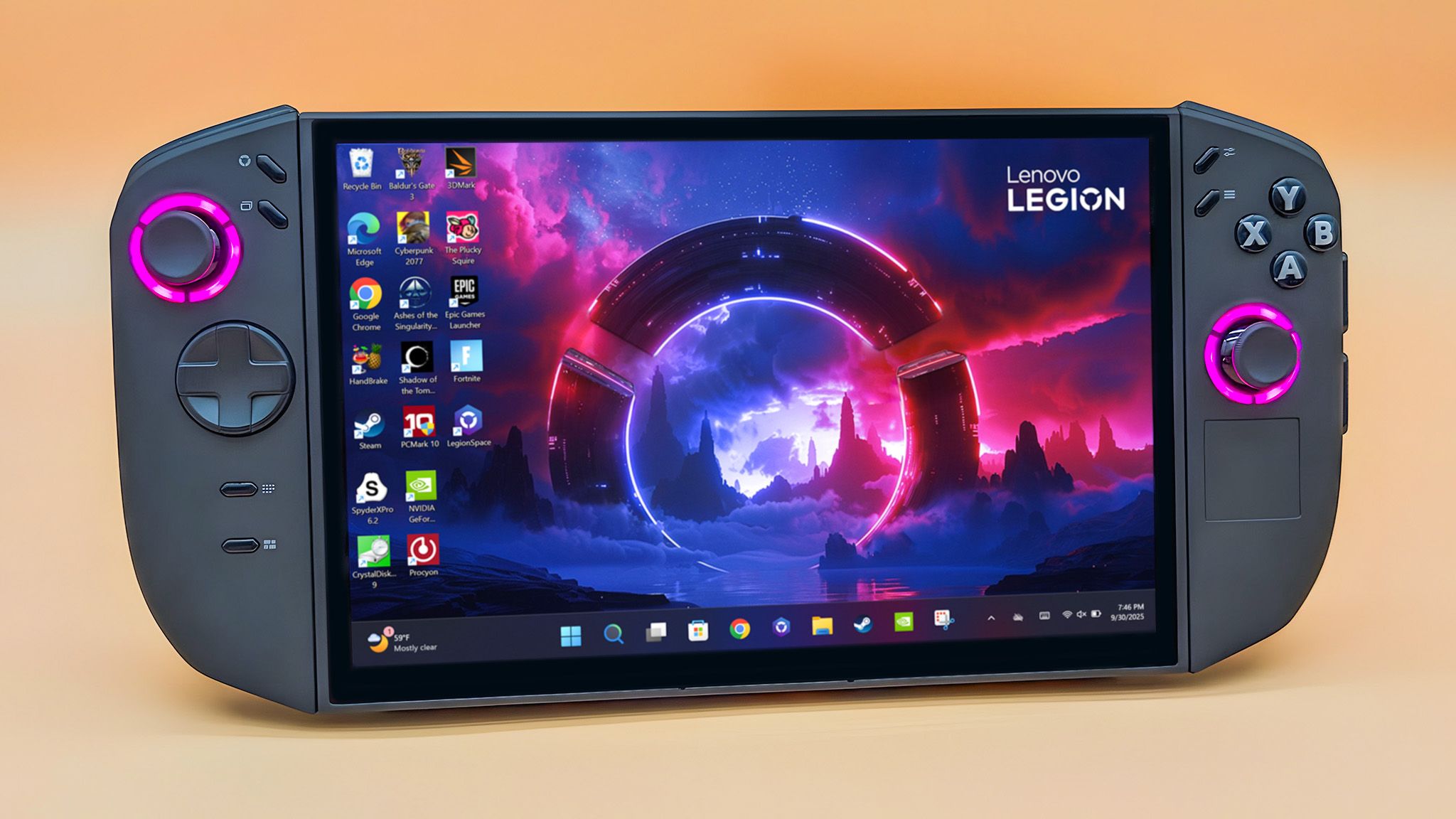
    The Lenovo Legion Go 2 standing upright with controller attached. The RGB lighting area around the joysticks glow pink.
    The Legion Go 2 has a more rounded shape than the original handheld. (Image credit: Rebecca Spear / Windows Central)

    The Lenovo Legion Go 2 in its case with the case lid partially covering the handheld.
    This handheld fits inside an included carrying case. (Image credit: Rebecca Spear / Windows Central)

    Just so you know, there are two variants of the premium Legion Go 2. I reviewed the Ryzen Z2 Extreme model.

    These are some of the most expensive Windows handhelds on the market. However, they also offer some of the nicest and most versatile features, so the cost makes sense given what’s on offer.

    If you tend to play less graphically demanding titles, then the base model might fit your needs. Otherwise, the Z2 Extreme model is the better choice for AAA games.

    Image 1 of 4

    The Lenovo Legion Go 2 in its case with the 65W wall adapter next to it.
    The included 65W wall adapter doesn’t fit into the included case. (Image credit: Rebecca Spear / Windows Central)

    The Lenovo Legion Go 2 case lying open with the FPS mode controller dock and a controller pin cover accessory sticking out from some pockets.
    There are pockets in the case for holding the FPS mod dock and a pin cover accessory. (Image credit: Rebecca Spear / Windows Central)

    The underside of the FPS mode base with the right Lenovo Legion Go 2 controller locked into it. There is a switch for releasing the controller and another switch for turning FPS mode on and off.
    The bottom of the FPS mode dock has a switch to lock the controller in place. (Image credit: Rebecca Spear / Windows Central)

    The Lenovo Legion Go 2 case, zippered closed.
    The included case doesn’t have a handle.(Image credit: Rebecca Spear / Windows Central)

    WHAT’S IN THE BOX?

    The box contains the Legion Go 2, a soft-shell case, an FPS mode base for the right controller, a rubber cover for the right controller’s pins when in FPS mode, and a 65W USB-C outlet adapter.

    The soft case has decent padding to protect against bumps, even if it isn’t as protective as a hard shell. Inside are two small pockets to hold the FPS mode base and the rubber pin cover.

    However, there is no room for the outlet adapter, and the case doesn’t have a handle for easy carrying.

    Recommended configuration

    DESIGN & UPGRADABILITY ⭐⭐⭐⭐

    Image 1 of 3

    The Lenovo Legion Go 2 facing away and propped up by its kickstand.
    Having a built-in kickstand makes it easier to use this handheld to watch shows or play games in tabletop mode. (Image credit: Rebecca Spear / Windows Central)

    A profile view of the Lenovo Legion Go 2 while it's leaning back a fair way on its kickstand.
    The kickstand can go back relatively far. (Image credit: Rebecca Spear / Windows Central)

    A view of the Lenovo Legion Go 2's top buttons, vents, volume buttons, USB4 port, and fingerprint reader.
    There are volume buttons, vents, a fingerprint reader/power button, and a USB4 port on top of the handheld. (Image credit: Rebecca Spear / Windows Central)

    Just about everything about the Legion Go 2 design is an improvement over the original handheld, except when it comes to upgradability.

    Reviewed Lenovo Legion Go 2 specs

    • Price: $1,349.99 at Best Buy
    • Display: 8.8” WUXGA (1920×1200), OLED, Multi-touch, 1100nits peak brightness, 100% DCI-P3, 16:10, 30-144Hz VRR
    • CPU: AMD Ryzen Z2 Extreme (8C, 16T, 15-35W cTDP)
    • GPU: AMD Radeon RDNA 3.5 Graphics, 16 cores
    • Memory: 32GB LPDDR5x-8000, soldered
    • Storage: 1TB M.2 2242 SSD, M.2 2280 slot
    • Connectivity: Wi-Fi 6E (802.11ax) 2×2 with Bluetooth 5.3
    • Ports: 2x USB4.0, 1x microSD card reader, 1x headphone jack
    • Size: 295.6 x 136.7 x 42.25 mm (11.64 x 5.38 x 1.66 inches)
    • Weight: 920g (2.03 lbs)

    Like the original, the Legion Go 2 features detachable controllers and a sturdy kickstand that props it up at multiple angles. This simple addition turns it into a versatile entertainment hub, not just a gaming machine.

    For instance, I’ve propped the handheld on my counter while cooking to follow recipes or stream shows before switching to handheld gaming after dinner.

    It includes two USB4 ports, which I appreciate, though the bottom placement of one makes it awkward to use when docked or in tabletop mode.

    The right controller still supports FPS mode and includes a dock for mouse-like control in cursor-heavy games, which makes this device more versatile than most Windows handhelds.

    I’m happy to report that the redesigned body feels more ergonomic, with rounded edges and better button placement that my fingers can better reach.

    The only exception is the two buttons below the D-Pad, but I don’t mind this since they don’t need to be reached in a hurry during gaming. One is used for toggling between open windows, while the other switches between the desktop and my game. I’ll dive deeper into controls later.

    WHAT ABOUT UPGRADABILITY?

    Image 1 of 3

    The Lenovo Legion Go 2 opened with the fan, battery, and SSD visible.
    The battery and fan must be removed to access the SSD. (Image credit: Rebecca Spear / Windows Central)

    The Lenovo Legion Go 2 opened with the battery removed to make the SSD more visible.
    The fan has a metal plate that extends over the SSD. This helps with cooling but makes SSD upgrades harder.(Image credit: Rebecca Spear / Windows Central)

    A closeup of the Lenovo Legion Go 2's SSD with a metal plate extending over it from the fan.
    I don’t recommend upgrading the Legion Go 2’s SSD unless you’re very comfortable with taking devices apart.(Image credit: Rebecca Spear / Windows Central)

    I previously upgraded the original Legion Go’s SSD with relative ease, as seen in my Legion Go SSD upgrade guide. However, the Legion Go 2’s internal storage is far trickier to upgrade.

    Accessing its SSD requires removing the battery and a glued-in fan that has plastic nubs holding it in place. Since it’s easier to damage components when removing these parts, I don’t recommend this upgrade for most users.

    This is a stark contrast to the upcoming Xbox Ally line, which seems to be leaning into upgradability, as evidenced by the new WD_BLACK SN7100X SSDs that are marketed for the Xbox Ally handhelds.


    BUTTONS & JOYSTICKS ⭐⭐⭐⭐⭐

    Image 1 of 2

    A closeup of the left controller while connected to the Lenovo Legion Go 2.
    There are additional buttons, Hall effect joysticks, and an improved D-Pad on the Legion Go 2. (Image credit: Rebecca Spear / Windows Central)

    A closeup of the left controller while connected to the Lenovo Legion Go 2.
    The single touchpad on the right controller works well. (Image credit: Rebecca Spear / Windows Central)

    I’ve already put dozens of hours of gaming sessions into the Legion Go 2, and its buttons, bumpers, and triggers remain snappy and responsive. Like its predecessor, it uses Hall effect joysticks, which don’t drift. This alone makes it a compelling handheld since competitors like Steam Deck and the Xbox Ally X don’t have Hall effect joysticks.

    The new D-pad design offers a more satisfying experience with a distinct and purposeful press that feels decidedly more under my control than the original handheld’s D-pad. Meanwhile, the slightly smaller touchpad still handles screen navigation well.


    DISPLAY ⭐⭐⭐⭐⭐

    Image 1 of 3

    A chart showing the excellent color gamut test results for the Legion Go 2's OLED display.
    The Legion Go 2’s OLED produced 100% of sRGB, 95% of Adobe RGB, and 100% of P3 in a color gamut test.(Image credit: Windows Central )

    A picture taken in a dark room of the Lenovo Legion Go 2's OLED display. It's showing a vibrant scene from Cyperpunk 2077.
    The OLED display produces vibrant colors, true black contrast, and crisp details. (Image credit: Rebecca Spear / Windows Central)

    Lenovo Legion Go 2 lying on its back and running Cyberpunk 2077.
    All of the games I played looked fantastic on the OLED display.(Image credit: Rebecca Spear / Windows Central)

    The Legion Go 2’s 8.8-inch 2K OLED display offers the best screen in handheld gaming to date. Period.

    Using my colorimeter, I found it produced an excellent 100% of sRGB, 95% of Adobe RGB, and 100% of P3 in a color gamut test, and gets as bright as 450 nits in SDR.

    Vibrant colors pop out strongly against true black contrast, with crisp details creating a rich visual experience from every gaming scene.

    What’s more, this screen is significantly larger than many other handheld displays, which helps pull me into my games.

    Additionally, the fact that the Legion Go 2 has a native landscape display that supports VRR (variable refresh rate) means that updates are more streamlined for this handheld than the original Legion Go, and motion clarity is far better on this screen as well.


    PERFORMANCE ⭐⭐⭐⭐

    Image 1 of 6

    Lenovo Legion Go 2 Geekbench 6 benchmarks showing the handheld got higher scores than all other handhelds in the test.
    The Legion Go 2 and its Z2 Extreme produced the best Geekbench CPU results of any handheld we’d previously tested.(Image credit: Windows Central)

    Lenovo Legion Go 2 3DMark Time Spy benchmarks showing the handheld got higher scores than most other handhelds in the test.
    Only the MSI Claw 8 AI+ beat the Legion Go 2 in terms of handheld GPU performance, of the devices we’ve tested so far.(Image credit: Windows Central)

    Lenovo Legion Go 2 Cinebench R24 benchmarks showing the handheld got higher scores than most other handhelds in the test.
    The Legion Go 2 produced excellent CPU rendering results in Cinebench R24.(Image credit: Windows Central)

    Lenovo Legion Go 2 CrossMark benchmarks showing the handheld got higher scores than all other handhelds in the test.
    The Legion Go 2 got the best Crossmark score of any handheld we’ve tested, telling us that if offers great overall system performance.(Image credit: Windows Central)

    Lenovo Legion Go 2 CrystalDiskMark benchmarks showing the handheld got higher scores than all other handhelds in the test.
    In a CrystalDiskMark test, the Legion Go 2’s SSD produced a super fast 7,153 MB/s read speed and a 6,553 MB/s write speed, which beat all other handhelds we’ve previously tested. (Image credit: Windows Central)

    Lenovo Legion Go 2 Handheld benchmarks showing the handheld transcoded a 4K copy of Tears of Steel faster than the MSI Claw 8 AI+ handheld.
    It took the Legion Go 2 41 minutes to transcode a 4K copy of Tears of Steel. This is one of the fastest times we’ve seen yet for a gaming handheld. (Image credit: Windows Central)

    The Legion Go 2 offered solid handheld performance, whether I was playing a 2D platformer or a more graphically demanding open-world game.

    Additionally, my various Legion Go 2 testing allowed me to see that this Z2 Extreme device does offer better performance than the original Legion Go and ROG Ally X with their Z1 Extreme processors, but usually only by modest gains.

    That said, since this device supports VRR, where the original didn’t, gameplay looks smoother on this device, even if FPS is only slightly higher.

    Gaming benchmarks

    I ran the following tests while the Legion Go 2 was set at Performance mode (30W TDP).

    • Ashes of the Singularity — 75.3 FPS (Normal preset, 1080p resolution, 240Hz refresh rate, V-sync enabled)
    • Ashes of the Singularity —  48.4 FPS (Heavy preset, 1080p resolution, 240Hz refresh rate, V-sync enabled)
    • Cyberpunk 2077 — 41.72 FPS (Low preset, Path Tracing and Ray Reconstruction disabled, 1200p resolution, 144Hz, V-sync disabled, AMD FidelityFX Super Resolution 2.1 set to “Auto,” frame generation disabled)
    • Cyberpunk 2077 — 38.66 FPS (Steam Deck preset, Path Tracing and Ray Reconstruction disabled, 1200p resolution, 144Hz, V-sync disabled, AMD FidelityFX Super Resolution 2.1 set to “Auto,” frame generation disabled)
    • Shadow of the Tomb Raider —  36 FPS (High preset, 1200p resolution, V-sync enabled)
    • Shadow of the Tomb Raider —  29 FPS (Highest preset, 1200p resolution, V-sync enabled)

    PC benchmarks

    Swipe to scroll horizontally
    Row 0 – Cell 0

    Plugged in

    Unplugged

    Geekbench 6 (CPU)

    11,963 multicore score, 2,805 single-core score

    9,969 multicore score, 2,120 single-core score

    Cinebench R24 (CPU)

    668 multicore score, 100 single-core score

    592 multicore score, 88 single-core score

    3dMark Time Spy (GPU)

    3,745

    3,546

    CrossMark (System performance)

    1,717

    1,175

    CrystalDiskMark (SSD speeds)

    7,153 MB/s read, 6,553 MB/s write

    3,581 MB/s read, 3,517 MB/s write

    Handbrake (4K transcoding)

    2,471 seconds

    2,720 seconds

    With the Legion Go 2 on Performance mode, refresh rate at 60Hz, and Cyberpunk 2077 graphics on the Steam Deck setting, the handheld managed an average 38 FPS (frames per second), which is slightly higher than the original Legion Go at the same settings.

    As is typical with AMD-toting devices, the Legion Go 2 offers higher performance when the handheld is powered by its 65W adapter versus when it is unplugged and going off of battery, so you’ll want to keep that in mind depending on what kind of game your running.


    THERMALS & FAN NOISE ⭐⭐⭐⭐⭐

    Image 1 of 4

    Thermal picture of the Lenovo Legion Go 2's screen measuring 101.8 degrees F around the center of the display.
    The Legion Go 2’s screen can get to be around 101 degrees F. (Image credit: Rebecca Spear / Windows Central)

    Thermal picture of the Lenovo Legion Go 2's backside, showing it gets hotter at the top near the vents.
    The backside of the handheld stays relatively cool.(Image credit: Rebecca Spear / Windows Central)

    Thermal picture of the Lenovo Legion Go 2's vents measuring 124.4 degrees F.
    The vents are the hottest part of the Legion Go 2, and they peaked at 124 degrees F. (Image credit: Rebecca Spear / Windows Central)

    Thermal picture of the Lenovo Legion Go 2 's right grip area, showing that it's 85.9 degrees F.
    I didn’t have to worry about the back of the Legion Go 2 being hot to the touch. (Image credit: Rebecca Spear / Windows Central)

    After running a CPU stress test for 20 minutes, readings from my thermal camera showed that the Legion Go 2 offers efficient cooling. The vents peaked at 124 degrees F (~51 degrees C), the screen and microSD area at 103 degrees F (~38.9 degrees C), and the backside at just 86 degrees F (30 degrees C).

    As is typical with handhelds, fan noise ramps up quickly, but doesn’t get overly loud in this case. I measured a peak of 35.2 dB when the handheld was at arm’s length and then 51.3 dB right next to the vents.


    SOFTWARE & CONNECTIVITY ⭐⭐⭐⭐

    Image 1 of 6

    A screenshot of the Legion Space program showing the current performance of the device.
    You can check the Legion Go 2’s current performance levels in Legion Space. (Image credit: Windows Central)

    A screenshot of the Legion Space program showing controller RGB settings for brightness and effect speed.
    Legion Space makes it easy to change controller RGB settings or turn them off. (Image credit: Windows Central)

    A screenshot of the Legion Space program showing the performance settings options.
    System performance and OS performance can both be changed in Legion Space.(Image credit: Windows Central)

    A screenshot of the Legion Space program showing the game launcher menu.
    Legion Space also serves as a game launcher and a game store. (Image credit: Windows Central)

    A screenshot of the Legion Space program showing the Performance side menu where you can change the device's thermal mode, fans, ans OS power mode.
    The quick menu makes it easy to change system settings on the go. (Image credit: Windows Central)

    A screenshot of the Legion Space program showing the general tab in the side menu where you can change resolution, refresh rate, brightness, volume, and more.
    It’s nice being able to adjust screen brightness or volume from this side menu. (Image credit: Windows Central)

    Legion Space comes preinstalled on the Legion Go 2, letting me adjust system and controller settings, launch games, or shop for more titles. A quick-access button on the right opens a menu for on-the-fly tweaks such as performance modes, fan speed, RGB presets, and screen brightness and resolution.

    The interface is simple and intuitive, but still lacks the deeper customization found in ASUS ROG’s Armoury Crate. For example, changing Legion Go 2 VRAM still requires diving into the BIOS, unlike the ROG Ally X, which handles it in software.

    But if you don’t mind not having as much control over your handheld, then this shouldn’t be an issue.

    A view of the Lenovo Legion Go 2's top buttons, vents, volume buttons, USB4 port, and fingerprint reader.

    A large fingerprint reader is located on top of the Legion Go 2, surrounded by the glowing Legion logo. (Image credit: Rebecca Spear / Windows Central)

    Unlike the original Legion Go, this next-gen handheld supports Windows Hello fingerprint login and has a large fingerprint reader on top that works flawlessly, in my experience.

    I connected various accessories to the handheld, including a wireless Xbox Controller via Bluetooth, a wireless headset via Wi-Fi, a wireless mouse and keyboard via USB-C dongle, and a docking station via a USB-C cable. Each of these connections worked beautifully without any hiccups or drops.

    By the way, the Legion Go 2 is larger than most handhelds, so my JSAUX 6-in-1 multifunctional docking station is my only dock that works with it.


    BATTERY LIFE ⭐⭐⭐⭐

    A closeup of the Lenovo Legion Go 2 65W USB-C wall adapter.

    The Legion Go 2 comes with a 65W USB-C wall adapter. (Image credit: Rebecca Spear / Windows Central)

    The Legion Go 2 has a larger 74Wh battery compared to the original Legion Go’s 49.2Wh battery. Despite this, I got similar battery life out of it when playing intensive games.

    • 2hrs 17 mins — Cyberpunk 2077 (Steam Deck preset) on Performance mode with screen at 68% brightness.
    • 5hrs 18 mins — Celeste on Efficiency mode with screen at 24% brightness.
    • 11hrs 30 mins — Running basic office tasks like website browsing and document writing with screen at 68% brightness.

    In the end, the Legion Go 2 might not run much longer when playing AAA games, but it still lasts as long as most other handhelds, so this is good in terms of handheld battery life.

    Lenovo Legion Go 2: Should you get it?

    The Lenovo Legion Go 2 propped up on its kickstand with the controllers detached and lying in front of it.

    The Legion Go 2 is a fantastic premium Windows handheld gaming PC whether you’re playing in handheld, tabletop, or docked mode. (Image credit: Rebecca Spear / Windows Central)

    ✅ You should buy this if …

    • You want a versatile Windows handheld that can be used in tabletop, handheld, and docked modes
    • You want the best handheld display to date

    ❌ You should not buy this if …

    • You don’t need a premium handheld with detachable controllers
    • You’re looking for a less expensive handheld that can still play AAA games

    Lenovo’s Legion Go 2 stands out in a crowded handheld market, even against heavyweights like the Xbox Ally X and Steam Deck. Its large OLED display with its vibrant colors, sharp detail, and VRR support helps envelop me in the digital worlds I engage with.

    The new rounded design feels much better in my palms, and my fingers are far more comfortable reaching the buttons. Meanwhile, having detachable controllers and a kickstand really make this device far more versatile than most other handheld gaming PCs.

    If you want an all-around portable entertainment device that also handles gaming, or you want a handheld with an amazing screen, then the Legion Go 2 is the device for you.

    Render of the Lenovo Legion Go (Gen 2) prototype on a white background.

    This next-gen handheld gaming PC offers an 8.8-inch 2K OLED display that supports up to 144Hz and VRR. There are two variants available, with the ability of having up to an AMD Ryzen Z2 Extreme with 32GB RAM, and 1TB SSD to meet your gaming needs.


    Click to follow Windows Central on Google News

    Follow Windows Central on Google News to keep our latest news, insights, and features at the top of your feeds!


    Lenovo Legion Go 2: Price Comparison

    Amazon UK View Similar
    Amazon
    Handheld Legion Lenovo review Screen
    Share. Facebook Twitter Pinterest LinkedIn Tumblr Email
    Previous ArticleThe new My Hero Academia game will finally let you live out the fantasy of playing through the anime’s big moments, but I’m still waiting for the Persona-style school sim
    Next Article Thursday Night Football: How to Watch 49ers vs. Rams Tonight
    techupdateadmin
    • Website

    Related Posts

    Gadgets

    Your next Legion Go 2 might run SteamOS instead of Windows 11

    December 21, 2025
    Mobile

    Huawei Mate X7 in for review

    December 20, 2025
    Gadgets

    Lenovo Legion Pro 5 gaming laptop deal packs OLED, RTX 5060, and 32GB RAM

    December 20, 2025
    Add A Comment
    Leave A Reply Cancel Reply

    Top Posts

    NYT Strands hints and answers for Monday, August 11 (game #526)

    August 11, 202545 Views

    These 2 Cities Are Pushing Back on Data Centers. Here’s What They’re Worried About

    September 13, 202542 Views

    Today’s NYT Connections: Sports Edition Hints, Answers for Sept. 4 #346

    September 4, 202540 Views
    Stay In Touch
    • Facebook
    • YouTube
    • TikTok
    • WhatsApp
    • Twitter
    • Instagram
    Latest Reviews

    Subscribe to Updates

    Get the latest tech news from FooBar about tech, design and biz.

    Most Popular

    Best Fitbit fitness trackers and watches in 2025

    July 9, 20250 Views

    There are still 200+ Prime Day 2025 deals you can get

    July 9, 20250 Views

    The best earbuds we’ve tested for 2025

    July 9, 20250 Views
    Our Picks

    My Health Anxiety Means I Won’t Use Apple’s or Samsung’s Smartwatches. Here’s Why

    December 22, 2025

    You can now buy the OnePlus 15 in the US and score free earbuds if you hurry

    December 22, 2025

    Today’s NYT Connections: Sports Edition Hints, Answers for Dec. 22 #455

    December 22, 2025

    Subscribe to Updates

    Get the latest creative news from FooBar about art, design and business.

    Facebook X (Twitter) Instagram Pinterest
    • About Us
    • Contact us
    • Privacy Policy
    • Disclaimer
    • Terms and Conditions
    © 2026 techupdatealert. Designed by Pro.

    Type above and press Enter to search. Press Esc to cancel.