


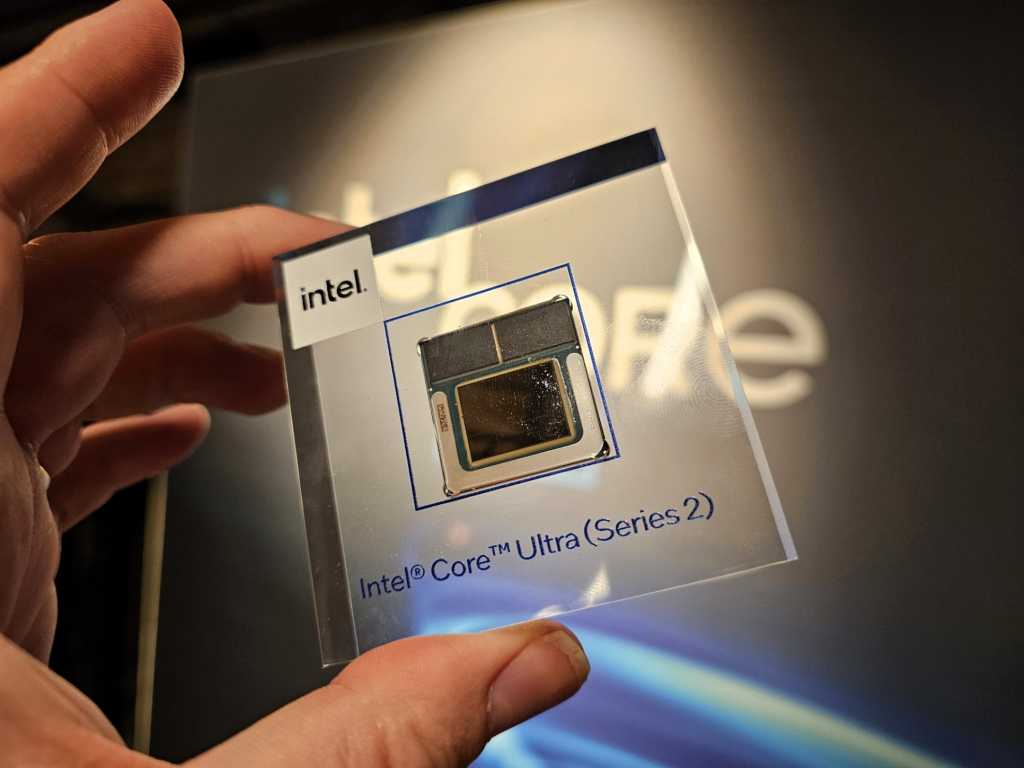
I recently reviewed the Alienware 16X Aurora (with its Arrow Lake-based processor) and the Alienware 16 Aurora (with its Raptor Lake-based processor), and both were branded as “Series 2” chips—neither were Lunar Lake! That started me down a rabbit hole: What exactly does Intel’s “Series 2” CPU branding mean these days?
Turns out, not a whole lot.
When Intel unveiled simple branding for its “Series 1” CPUs, it was clear what we were getting. With “Series 2” and the launch of Lunar Lake, I thought Intel Core Ultra Series 2 CPUs were going to be AI PCs with long battery life and NPUs capable of running Copilot+ PC features… but that’s not true anymore. It’s more confusing than that.
Intel’s “Series 2” branding doesn’t tell you much. You need to dig into model numbers and CPU architecture details to understand what’s going on—just like in the days before Intel simplified its CPU branding.
The promise of Intel’s “Series 1” naming scheme, explained
In 2023, Intel shook up its branding and aimed to simplify everything. On the mobile side—this is going to be complicated enough without dragging in desktop processors—you had “Intel Core (Series 1)” chips and “Intel Core Ultra (Series 1)” chips.
Intel Core Ultra chips were Meteor Lake chips, early “AI PC” hardware with neural processing units and better power efficiency. The architecture never fully delivered on its grand promises, though: battery life improvements weren’t as massive as we’d hoped for, and the NPUs weren’t powerful enough to meet Microsoft’s Copilot+ PC requirements. They could be branded Intel Core Ultra 3, 5, 7, or 9.
Meanwhile, Intel also had Raptor Lake chips—the previous architecture—which were branded Intel Core 3, 5, and 7 (no 9). These chips delivered higher performance for gaming PCs and workstations at the cost of higher power usage. In short, gamers looking for higher CPU performance needed to avoid the “Ultra” branding in Series 1 chips.
While the use of “Ultra” to mean “a swanky new AI PC and not a top-performance CPU” was a little odd, the overall naming scheme mostly made sense. You could see “Series 1” and look at “Core Ultra 5” or “Core 7” and understand what you were getting.
Then, it all started getting muddled again. As we get into the weeds, it’s important to remember that Intel’s CEO left at the end of 2024, which matches the timeline of when the company’s marketing strategy shifted away from its original simplified branding.
The Core i9-14900HX showed holes in the Series 1 naming strategy
In early 2024, Intel launched the Intel Core i9-14900HX processor. This was a performance monster—the fastest mobile CPU we ever tested at the time at PCWorld! But the naming was a bit confusing since Intel had dropped the “i” from its Meteor Lake CPUs, yet now it was back. That’s because this HX processor was from the Raptor Lake Refresh architecture, an updated version of a previous architecture.
Wait. Didn’t Series 1 already encompass some Raptor Lake chips? Yes… but Intel had gotten rid of the “9” from the Core line, and Intel couldn’t call it a Core “Ultra” because that was reserved for Meteor Lake chips with NPUs. And I bet that the “Core i9” branding looked better for a high-performance gaming-focused CPU than mere “Core 7” branding.
Gamers seeking high-end performance would almost certainly look for branding markers like “Ultra” and “9,” but Intel had reserved them for its AI PC chips that prioritized power efficiency and NPU acceleration over top-end performance.
Intel’s “Series 2” branding was supposed to be Lunar Lake, right?
Intel started using the “Series 2” naming scheme when it launched Lunar Lake chips in September 2024.
There was a lot of hype around these “Lunar Lake” chips or “Core Ultra Series 2” processors, as they were what the Series 1 chips should have been. The NPU for AI features aside, they also delivered long battery life that went toe-to-toe with Qualcomm’s Arm-based Snapdragon X chips.
I saw so much coverage of Series 2, and so much of that coverage tied the Series 2 branding to Lunar Lake and its battery life and NPU goals. Did I misunderstand Intel’s marketing? Maybe! But if so, I wasn’t the only one who was confused—and that’s my point. It’s gotten messy again.
Intel’s Series 2 now includes Raptor Lake and Arrow Lake CPUs
All of this brings us back to the laptops I mentioned at the start of this article: the Alienware 16 Aurora and Alienware 16X Aurora.
The Alienware 16 Aurora had an Intel Core 7 240H, which was branded an “Intel Core (Series 2)” processor. However, it’s based on the older Raptor Lake architecture, which was already a previous-generation architecture when the Series 1 collection launched with Meteor Lake at the “Ultra” tier. Despite all the AI PC talk, this Series 2-powered laptop had no NPU—you couldn’t even use Windows Studio Effects for webcam effects. A big strike for Series 2 confusion.
Meanwhile, the higher-end Alienware 16X Aurora had an Intel Core Ultra 9 275HX chip, which was branded an “Intel Core Ultra (Series 2)” chip, just like the newest Lunar Lake chips. However, this one wasn’t Lunar Lake—it was a higher-end gaming chip with better performance, kind of like that Core i9-14900HX that was launched during the Series 1 era but wasn’t slapped with Series 1 branding. To be fair, it’s a great chip for gaming and it does have an NPU, but the NPU doesn’t meet the bar for Copilot+ PC features and it lacks Lunar Lake’s battery efficiency.
So, what does all of this mean? Right now, an “Intel Core Ultra (Series 2)” processor can either be a high-end Arrow Lake gaming CPU without the chops to run Copilot+ PC features or a power-efficient Lunar Lake CPU that does meet Microsoft’s Copilot+ requirements.
As always, the CPU’s model number and architecture remain key
The fundmental point I’m trying to make is that “Series 2” doesn’t tell you much. Even “Core Ultra” doesn’t tell you much!
Intel’s website brands these naming schemes as “product collections,” but you really need to look at a CPU’s model name and processor number to understand what you’re getting. “HX” means a powerful Arrow Lake CPU while “V” means a power-efficient Lunar Lake chip, for example. But I thought the simplified branding was meant to do away with that.
If Series 2 can include so many different chips with so many different characteristics, I’m not sure what a “product collection” is aside from simply “a collection of CPUs released during a certain era”—and at the end of the day, how helpful is that for consumers? Not very.
Shiny new branding, same old confusion
Tech journalists have been criticizing confusing CPU and GPU branding for many years, and Intel has always been at the center of that.
If Intel had stayed the course with its previous branding, none of this would be surprising—but Intel went out of its way to simplify things, and that simplified branding has already become complex in just a year. That, to me, makes it a failure that misses the mark.
Intel once slammed AMD’s Ryzen naming scheme for being “snake oil” that marketed dated architectures as part of modern processor families. As Intel’s own presentation put it back in 2023, talking about AMD’s Ryzen branding: “Can I trust that this is the latest?” “No!”
Well, that’s how it feels with Series 2. I struggle to follow all these twists and turns, and I’m a professional tech journalist who reviews laptops! I shouldn’t need an email from Intel PR to grasp what the heck “Series 2” actually means, and neither should you.
