


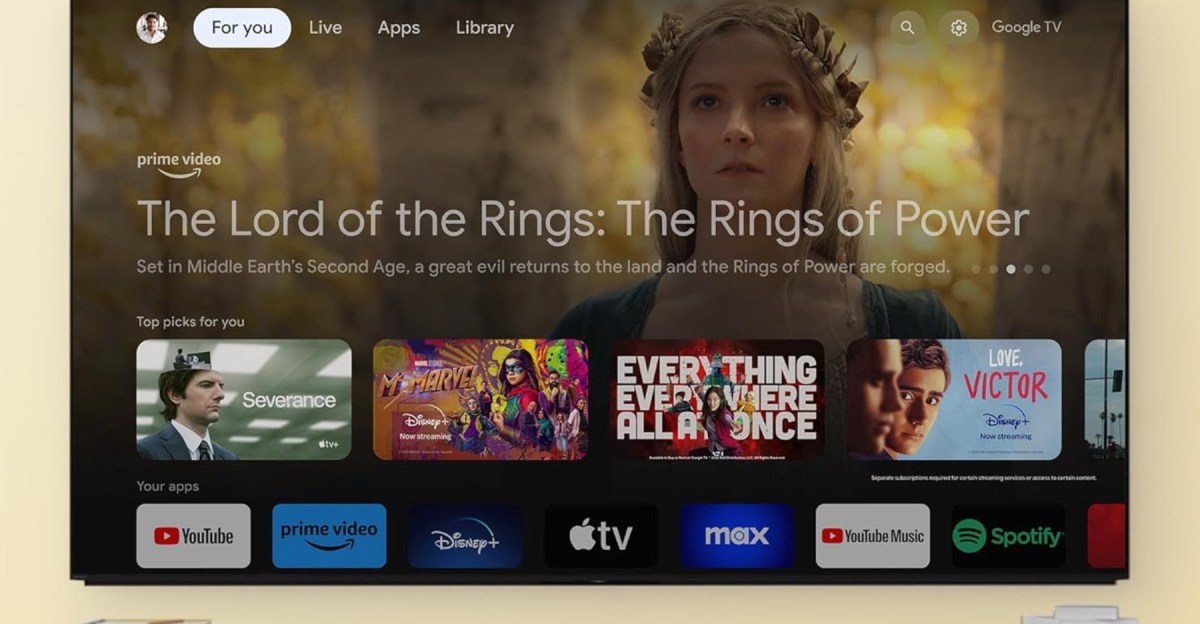
Last year, Google surprised online video publishers with some stunning news: the company, which now generates over a quarter trillion dollars with advertising every year, effectively admitted that it isn’t very good at selling ads for its own smart TV platform, Google TV.
The issue at heart: Google has long required publishers to share a percentage of their ad inventory to be on Google TV. It’s a common industry practice. Companies like Roku or Vizio routinely sell a subset of the ad spots you see when you watch videos from third-party publishers on their smart TVs, and they pocket the money as compensation for operating their smart TV platforms.
But Google changed course on its own deals with publishers out of the blue and gave previously requested ad spots back to them, I was able to confirm with three sources with knowledge of those changes. The company is now just asking for a cut of their ad revenue — a tacit admission that these companies are better at selling their own advertising.
The policy change is just the latest example of something that has plagued Google for a long time: after growing Google TV into a major smart TV platform, Google has struggled to monetize it. The company has been spending hundreds of millions of dollars on Google TV every year, but it has yet to break even on those efforts, I’ve been told by two sources with knowledge of the issue. And with costs exploding, the company now finds itself at a crossroads, forced to decide how much it is willing to pay to stay relevant in the smart TV space.
Google TV grew fast, but monetization is lacking
Google’s current smart TV efforts reach back all the way to 2014, when it launched Android TV as a way to bring Android to the living room. Those efforts were supercharged in 2020, when it unified Chromecast and Android TV under the Google TV banner, complete with a new TV UI that put a bigger emphasis on content discovery. The plan, I’ve been told, was to follow the company’s mobile playbook: invest in scale first and then ramp up monetization.
Google’s TV team has arguably succeeded with the first part of that mission. The company announced a milestone of 270 million monthly active smart TVs and TV-connected devices last September; one source in the know told me that it has likely surpassed the 300 million mark since then.
However, many of those devices are in overseas markets that are much more difficult to monetize, and a good chunk are running what’s known as the Android TV operator tier — a version of Android’s smart TV software that can be heavily customized by pay TV operators and often leaves little, if any, room for Google to make any money.
That’s why it’s so important for Google to have a foothold in the North American smart TV market, where it has partnered with companies like Sony, TCL, and Hisense to run Google TV on their TV sets. However, doing so comes with significant costs — and it is only getting more expensive, thanks to some aggressive moves from Google’s archrival Amazon.
Last year, Amazon announced it would begin selling Hisense-made Fire TVs at Costco. Left out of the announcement was the fact that these TVs would be replacing Hisense-made TVs running Google TV.
Amazon was able to boot Google from Costco’s shelves by spending heavily on something that is known in the industry as bounties: every time Costco sells a Hisense Fire TV, Amazon sends some money to Hisense and Costco. The exact terms of those deals are confidential, but I’ve been told by two sources that Amazon likely ends up paying as much as $50 total per activated TV. Amazon declined to comment when contacted for this story.
Google has been paying these kinds of bounties to TV makers and select retailers, as well, but not at Amazon’s levels. Faced with the prospect of having to dole out much more money to retain shelf space and keep hardware partners happy, some in the company are now questioning whether Google TV is really worth it.
“The success of our platforms is rooted in the success and scale of our partners, app developers and services, including our own,” said Shalini Govil-Pai, Google’s vice president and general manager of TV platforms, when contacted for comment for this story. “While we may have specific business arrangements with our partners, our focus is and has always been to lead in product innovation and user experience. This is reflected in high user ratings and a global reach of over 270 million monthly active users. We continue to invest in Google TV because we believe the TV remains the center for families to gather and be entertained.”
YouTube doesn’t need Google TV
All of that is happening as YouTube is seeing massive success in the living room: TV-based YouTube viewing has skyrocketed in recent years. The video service accounted for 12.5 percent of all TV viewing in the US this May, and now makes up 25 percent of all TV-based streaming. YouTube’s ad revenue was $9.8 billion last quarter.
In light of that, Google’s salespeople are prioritizing YouTube over Google TV, which was one reason for the decision to change revenue-sharing terms with publishers. And while having its own smart TV platform was initially seen as a bargaining chip in negotiations to get YouTube onto third-party devices, there’s now little need for that: YouTube has become so huge that it can effectively dictate contract terms to other device makers. As a result, YouTube executives have shown little interest in Google TV, with some openly arguing that Google would be better off spending Google TV’s budget on YouTube instead.
There are already signs that Google is rethinking its spending on Google TV: The Information first reported about budget cuts affecting Google TV in June. But while that report largely focused on layoffs, I’ve been told by multiple sources that the number of people let go was actually in line with the company’s broader cutbacks across its devices and services unit. The real issue, I’ve been told by three sources, is a growing discomfort within Google to keep footing the bill for Google TV’s retail shelf space bounties.
For the time being, the company is still paying these bounties. However, a source with knowledge of those conversations told me that Google has been looking for shorter terms for the kinds of commercial agreements with TV makers that govern bounties, indicating that it may scale back its investment level on those bounties in the near future.
What comes then is anyone’s guess. It’s unlikely that Google would abandon its TV efforts altogether. But with a much smaller budget and unable to effectively compete with companies like Roku and Amazon, there is a possibility that the company could treat smart TVs similar to the way Apple has long approached the space: as little more than an expensive hobby.
This is Lowpass by Janko Roettgers, a column on the ever-evolving intersection of tech and entertainment, syndicated just for The Verge subscribers once a week.
