


Why you can trust TechRadar
We spend hours testing every product or service we review, so you can be sure you’re buying the best. Find out more about how we test.
Cambridge Evo 150 SE: Two-minute review
A little over four years after it launched its well-regarded Evo 150 music streaming amplifier, Cambridge has given it the once-over and rechristened it Evo 150 SE. The differences are not numerous, but they are noteworthy nonetheless – and that’s even before you take into account the fact that this new model is actually less expensive than the model it replaces.
A neat form factor, with swappable side panels a particularly nice touch, a big, bright display and several very decent control options are all carried over. So is the expansive selection of digital and analogue, wired and wireless input options. Power, at 150 watts per channel into 8 ohms, is unchanged too – but now the Hypex NCOREx Class D amplification is ‘tuned by Cambridge’. This is by far the most significant differential between the 150 SE and the outgoing 150.
It makes its presence felt, too, in the weighty, punchy (and ultimately fractionally overstated) low frequency reproduction. But it hasn’t affected the machine’s ability to create a big soundstage, to extract and deliver lots of detail, to manage a rhythm confidently, or to generate a large and persuasive soundstage.
Add in great ergonomics, a fine standard of build and finish and the ability to drive a couple of pairs of speakers without alarms, and it’s apparent the Cambridge Evo 150 SE is a very worthwhile proposition indeed. Even if it doesn’t look all that different to the product it replaces.
Cambridge Evo 150 SE review: Price and release date
- Release date: July 2025
- Price: $3,299 / £1,999 / AU$5,999
The Cambridge Evo 150 SE launched in July 2025, and in the United Kingdom it sells for £1,999 – the same price as the outgoing Evo 150 had hit after launching at £2,249 back in 2021. In the United States you should expect to pay $3,299, while in Australia it’s currently listed at AU$5,999.
Of course, the market for streaming amplifiers is hotting up nicely – brands as venerable as NAD and as up-and-coming as Eversolo have products contesting this region of the market. So simply having a decent reputation for this sort of thing is only going to carry Cambridge (and the Evo 150 SE) so far…
Cambridge Evo 150 SE review: Features
- 150 watts of Hypex NCOREx ‘Tuned by Cambridge’ Class D amplification
- Numerous wired and wireless, analogue and digital inputs
- Four-layer PCB
There was very little wrong with the feature-set of the original EVO 150, so Cambridge has (very sensibly) left well enough alone. Or, at least, it has in all but one very significant area.
So what’s carried over from the outgoing model? Well, there’s the remarkably generous selection of physical and wireless inputs and outputs, for starters. Where analogue stuff is concerned, the Evo 150 SE has a line-level unbalanced input on stereo RCAs, a balanced equivalent via XLRs, and a moving magnet phono stage for use with a turntable accessed by another pair of RCAs. Digital inputs run to a digital coaxial input, a digital optical socket, an HDMI ARC and a USB-B input.
Wireless stuff is handled by dual-band wifi and Bluetooth with aptX HD codec compatibility. Wi-fi, of course, means the Cambridge can deal with AirPlay 2, Chromecast, Spotify Connect and TIDAL Connect – and it also gives access to internet radio. The 150 SE is Roon Ready, too.
As far as outputs go, there are binding posts for two pairs of speakers and a 3.5mm headphone socket. In addition, there’s a pre-out for a subwoofer, corresponding pre-outs for use with a power amplifier. And the Cambridge is a Bluetooth transmitter as well as a receiver, so it can drive your wireless headphones.
Incoming digital signals are handled by an ESS Sabre ES9018K2M digital-to-analogue converter that can deal with resolutions of up to 32bit/384kHz and DSD256. The Cambridge is compatible with all popular file types, and quite a few unpopular ones too.
So far, so very-similar-indeed-to-the-old-model. But what makes this machine an ‘SE’ is the fact that Cambridge has worked in such close collaboration with Hypex on its NCOREx Class D amplification that here it’s branded as ‘Tuned by Cambridge’. And it is, at least according to the companies involved, ready and able to produce “warm, dynamic and controlled sound”.
Features score: 5 / 5

Cambridge Evo 150 SE review: Design
- 39 x 317 x 352mm (HxWxD)
- Large, bright, full-colour display
- Swappable side panels
Just as with ‘features’, not a lot has changed where the design of the Evo 150 SE is concerned – it demonstrably wasn’t broken, and so Cambridge has chosen not to fix it. Unlike the ‘features’ section, though, where there’s a difference here between the 150 and this 150 SE it is absolutely trifling.
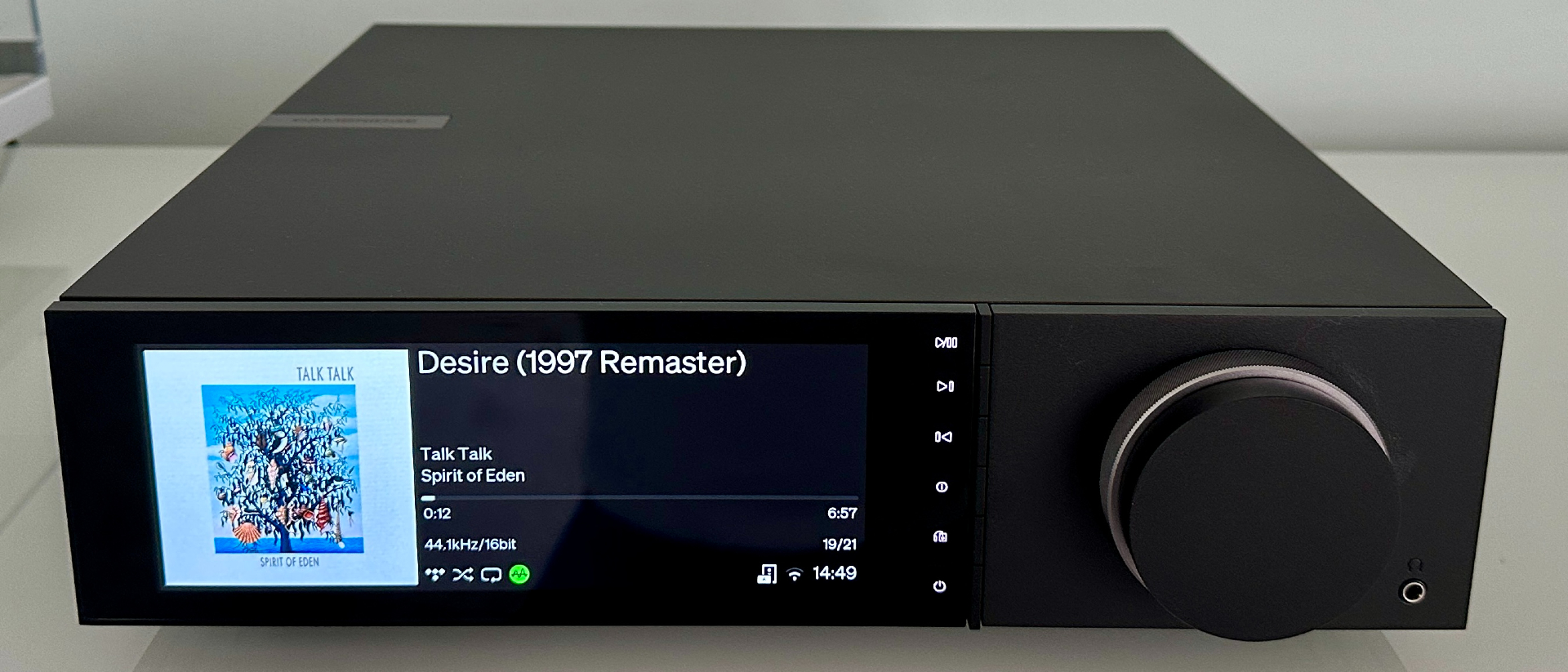
So your £1999 buys you a nicely proportioned, beautifully made and flawlessly finished box with a bright, crisp full-colour display on the fascia that will display album artwork or virtual VU meters as well as providing menu and set-up options. The Evo 150 is supplied with two pairs of side-panels that attach magnetically and can easily be swapped – one is a real wood veneer, the other a dark grey slatted alternative.
So yes, the difference between the Evo 150 and this Evo 150 SE is – hold on to your hat – the knurling of the two-part volume dial/input selector. It’s less knurled than it was before.
Design score: 5 / 5

Cambridge Evo 150 SE review: Sound quality
- Detail and dynamism in equal measure
- Big, organised soundstage
- Slightly overconfident low-frequency reproduction
There are differences between the way the Evo 150 SE sounds when delivering a DSD64 file of Tears For Fears’ Head Over Heels via some network-attached storage compared to the same song streaming from the free tier of Spotify, of course – but one of the most admirable things about this Cambridge machine is how consistent it sounds. No matter which of its inputs you’re using, its fundamental character comes through loud and clear.
And broadly speaking, its character is a lovely balance between ‘detail’ and ‘energy’, and between ‘scale’ and ‘dynamism’. The Evo 150 SE is capable of revealing the finest, most minor details in a recording, and giving them the appropriate amount of emphasis relative to the overall performance. It invests music with the sort of vigour and momentum that can bring it to life, without ever threatening to lose control of proceedings. It creates a large and well-defined soundstage, and ensures that every element of recording (no matter how numerous the elements might be) gets the required elbow-room to express itself – though it delivers music as a unified and singular piece at the same time. It has the sort of dynamic headroom that allows it to track the shifts in intensity or volume during the course of a recording without sounding pressured or stressed.
At the top of the frequency range, the Evo 150 SE attacks with chunky determination. Treble sounds have brilliance and a fair amount of bite, but they’re substantial enough to prevent any hardness or edginess creeping in. It’s a similar story through the midrange: the Cambridge is forward and direct, but never pushy, and it reveals a big amount of information, both broad and fine, about what’s going on there. Voices, in particular, benefit no end from this eloquence and positivity.
The tonal balance up to this point, and down into the low frequencies too, is almost (but not quite) neutral – there’s just a hint of warmth that suits the overall character of the Evo 150 SE just fine. The frequency response, though, is slightly skewed. The Cambridge puts slightly more emphasis on the bottom end than is absolutely ideal, with the result that the overall presentation is slightly tiled towards bass. It’s not that the low end here lacks detail or is in any way ponderous – the Evo 150 SE controls the low frequencies carefully at their attack and decay, and expresses rhythms confidently as a result. But while there are doubtless plenty of listeners who will interpret this slight bottom-heaviness as ‘exciting’, it serves to make the Evo 150 SE sound less than neutral. And to demand you take some care with partnering equipment, especially loudspeakers.
Having praised the Cambridge for the consistency of its sound through its numerous inputs, it’s nevertheless worth pointing out just what a gem the Evo 150 SE’s phono stage is. A vinyl copy of The Cinematic Orchestra’s Every Day sounds full, dynamic to almost comical degree, lavishly detailed and is delivered with complete positivity. Yes, that tilt towards the bottom end is still in evidence – but the way the Cambridge handles the various rhythms and tempos goes an awfully long way towards making up for it.
Sound quality score: 4.5 / 5

Cambridge Evo 150 SE review: Usability & setup
- Remote handset or app control
- Simple to get attach to your local network
- Big-print on-screen menus are nicely realised
Control is available via the on-screen menus and the input dial, or via the perfectly adequate yet entirely unremarkable remote control handset. Or you can do what all sensible people will do, and use the fourth (and current) version of the StreamMagic control app. This is a comprehensive, logical, stable and usable app, which offers a lot of options – I’m particularly keen on the ability to include only those inputs you’re using on the home screen. It’s good for integrating your favourite music streaming services, saving half a dozen internet radio stations as presets, and plenty more besides.
As far as ‘setup’ goes, it’s simply a question of making the physical connections you want to make, and then getting the 150 SE on to your local network. It behaves as an AirPlay speaker when fresh out of the box, so finding it and hooking it to your network couldn’t be easier (unless you’re using an Ethernet connection to your router, which makes it easier still). Then load up your streaming services and internet radio stations, nominate the inputs you’re using to the front of the app, and away you go.
Usability & setup score: 5 / 5

Cambridge Evo 150 SE review: Value
When the original Evo 150 launched back in 2021, it cost £2249 – and everyone seemed to think that was fair enough. Somehow Cambridge has managed to retain everything that was great about the original, dial in some upgraded amplification and lower the asking price to an extremely eye-catching £1999. So yes, there’s splendid value for money here.
Value score: 5 / 5

Should you buy Cambridge Audio Evo 150 SE?
Buy it if…
Don’t buy it if…

Cambridge Audio Evo 150 SE review: Also consider

How I tested the Cambridge Audio Evo 150 SE
- Two-week testing period
- Bowers & Wilkins speakers
- Rega P1 turntable; network storage; Tidal Connect, internet radio
With a pair of Bowers & Wilkins 702 S3 Signature at the business end, with a Rega Planar 1 turntable as a physical source and a mixture of Tidal Connect, network-attached storage, internet radio and various devices attached via Bluetooth at the other end, the Cambridge Evo 150 SE always held its own.
No genre of music seemed to be off-limits, and it wasn’t as ruthless with lower quality content as it might have been – try as I might, I couldn’t make it insist on hi-res stuff. Which means it was a pleasure to listen to in pretty much every circumstance.
First reviewed August 2025
