


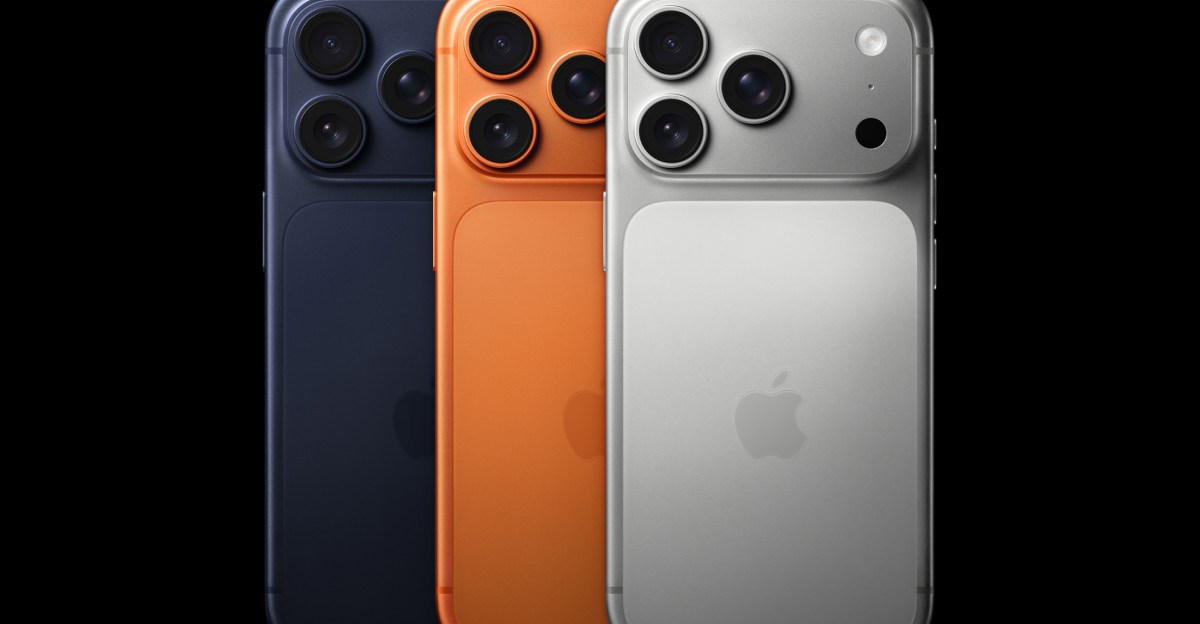
Apple has announced the iPhone 17 Pro and Pro Max, the top models in its new iPhone 17 lineup, alongside the regular iPhone 17 and all-new iPhone Air. The Pro returns to an aluminum build, adds the biggest battery of any iPhone yet, and boasts what Apple is calling a “full-width camera plateau” on the back.
The obvious change this year is a dramatic redesign of the rear camera module — sorry, “plateau” — which now stretches all the way across the body, rather than only containing the lenses. It looks just a little like the wide camera bar on Google’s Pixel phones, and funnily enough we’re already expecting to see Samsung adopt a similar design in its S26 range next year.
It’s still a triple camera within that new camera island, though there’s been one major upgrade: for the first time this year’s Pro models feature 48-megapixel sensors across all three cameras.
The telephoto is the lens getting a bump here, with a significant resolution improvement from the 12-megapixel telephoto lens found on last year’s models. It’s not only higher resolution — the telephoto packs a 56 percent larger sensor too, and Apple says it can deliver up to 8x optical quality zoom.
The selfie camera is also improving, with a new 18-megapixel sensor that uses Center Stage to dynamically frame every photo, matching this year’s other iPhone models. You can even use it to take landscape selfies while holding the phone in portrait mode.
The big video upgrades are Dual Capture, which allows you to simultaneously record from both front and rear cameras, and support for ProRes RAW, Log 2, and genlock, as Apple continues to make the case that its Pro iPhones are good enough for pro videographers.
The phones come in only three colors: silver, blue, and an eye-catching orange that’s much more colorful than we’re used to from the Pro phones. There are other changes to the design that are harder to spot though: Apple has switched from titanium back to an all-aluminum build, and now both the front and back of the phone are made with the scratch-resistant Ceramic Shield, with the extra tough second-generation coating on the front.
Despite the redesign, there’s been no major change to the Pro models’ sizes. The 17 Pro offers a similar 6.3-inch display to last year’s 16 Pro, with the 17 Pro Max at 6.9 inches. As before, the screens themselves support ProMotion, with up to 120Hz refresh rates, though that’s less unique than it used to be, with ProMotion finally supported on the base iPhone too this year. In fact, the only real display improvement is higher peak brightness of 3,000 nits, also found on all four phones this year.
The chipset inside the phones has been upgraded year-on-year too. Like the new Air, the two Pro phones are powered by the A19 Pro chip, promising the usual improvements in performance and efficiency. It’s a 3nm chip with a six-core CPU, which Apple says is “the fastest in any smartphone,” and six-core GPU.
Unlike the Air, the Pro comes with what Apple says is its biggest battery ever in an iPhone, delivering its best ever battery life. That means up to 39 hours of video playback in the Pro Max, compared to 33 hours for the 16 Pro Max. You’ll only get that top performance if you buy an eSIM-only version of the phone, like that sold in the US, with Apple using the extra space to cram in more power — it says phones with the physical SIM will run for two hours less.
Charging has been improved too, with support for faster 25W MagSafe wireless charging. Those speeds were introduced in the recent Qi2.2 25W standard, which is based on MagSafe tech, but until now only the Pixel 10 Pro XL has supported it.

Earlier this year, Apple announced iOS 26, the latest version of its iPhone software, which brings with it a significant change to the look and feel of your phone: Liquid Glass. It’s got big transparent energy, making various UI elements glossy, glassy, and see-through — it might take some getting used to. iOS 26 will be on the new iPhones out of the box, and arrives on other models from September 15th.
Last year’s iPhone 16 Pro was a relatively cautious update that added bigger screens, better battery life, and a Camera Control button along the side of the phone. The 16 series also marked Apple’s first serious push into AI, with the ill-fated launch of Apple Intelligence, which has long lagged behind competitors and was criticized for failing to deliver on some features announced over a year ago.
The iPhone 17 Pro starts from $1,099, with the Pro Max starting at $1,199, both with 256GB of storage. That’s a slight price hike for the Pro, but it’s in line with the 16 Pro’s 256GB version. For the first time, the Pro Max can be equipped with up to 2TB, which will set you back $1,999.
Preorders open this Friday, with full availability from September 19th.
0 Comments
