


Why you can trust TechRadar
We spend hours testing every product or service we review, so you can be sure you’re buying the best. Find out more about how we test.
GL.iNet Comet: 30-second review
The GL.iNet Comet (GL-RM1) is a compact, hardware-based KVM-over-IP device. It allows you to remotely control a computer (desktop, server, or headless system) at the BIOS level, even if the OS isn’t running. It’s designed for IT professionals, homelab enthusiasts, and anyone needing reliable remote access without ongoing subscription fees.
With a base price of around $80-90, and discounts for bulk purchases, this isn’t an expensive option for those who need to control computers that aren’t in the same location.
There are alternative options, like JetKVM, that offer a WiFi connection the Comet doesn’t include, but they are also more expensive.
For another $13, GL.iNet makes a small board that can be fitted to a desktop PC, which will help remotely power up that machine without getting Wake-on-LAN to work reliably or having someone physically power it up. The brand also has another gizmo intended to help power remote laptops: the Fingerbot, which is designed to press the laptop’s power button.
One good reason not to buy this device, from our perspective, is that the Comet PoE (GL-RM1PE) exists —a version of this hardware that can be powered by a PoE network connection for even greater flexibility. That costs another $25, but it allows you to use this with systems that don’t power their USB ports when they shut down.
Overall, the GL.iNet Comet is a product that lives up to its promises, and for a small outlay, it could avoid unnecessary journeys or the need for assistance.
GL.iNet Comet: price and availability
- How much does it cost? $90/£90/€90
- When is it out? Available now globally
- Where can you get it? Direct from GL-iNet and online retailers.
GL-iNet keeps the pricing of the Comet remarkably straightforward, costing $89.99 in the USA, £89.90 in the UK and €89.87 in Europe. That seems like a better deal for Americans, for some inexplicable reason, but GL-iNet picks up the bill for international shipping for US, Canadian, European, and Asia Pacific customers.
The two potential accessories are the ATX board for desktop systems, costing $15.90/£12.90/€18,92 and the hilariously named Fingerbot, which is $29.99/£22.90/€30.93, making the UK the best place to source those items.
As an alternative made by GL-iNet themselves, the Comet PoE (GL-RM1PE) is $109.99/£106.99/€119.99, but his model has proven so popular that it’s out of stock in some regions at this time.
Most of these items can be found on Amazon for the same prices, if you prefer that retailer. I’m seeing it on Amazon.com and Amazon.co.uk right now.
The most popular product with a similar capability is the JetKVM, which sells for the same price in the UK via wisfPi. And the makers of that hardware also have a $19 ATX card and a $35 separate PoE splitter. What they don’t offer is anything like the Fingerbot, yet.
There are some options for cards that combine the functionality of the Comet with the ATX card, but these are exclusively for desktop or server installs. These can be found as cheaply as $60.
But for self-contained solutions, the Comet seems reasonably priced, and the accessories also won’t bust the budget.

GL.iNet Comet: Specs
|
Feature |
GL.iNet Comet (GL-RM1) |
|---|---|
|
Type |
KVM-over-IP (hardware-based) |
|
Video Support |
Up to 4K @ 30fps, audio passthrough |
|
Remote Access |
BIOS-level (even if OS/network is down) |
|
Connectivity |
Ethernet only (no Wi-Fi) |
|
USB Ports |
1 x USB-A 2.0 (no USB 3.0/3.2) |
|
Power Input |
USB-C (5V/2A, adapter not included) |
|
Onboard Storage |
8GB eMMC |
|
Web Interface |
Yes (no client software required) |
|
Security |
Hardware isolation, 2FA, Tailscale VPN |
|
Accessories |
Optional ATX board, Fingerbot |
|
Subscription Fees |
None |
|
Firmware |
Updatable |
|
Dimensions |
80 x 60 x 17.5mm |
|
Weight |
85g |
|
Included Cables |
All except the power adapter |
|
Warranty |
2 years |
GL.iNet Comet: design
- Small and potent
- Lacks a power adapter
- No through-ports
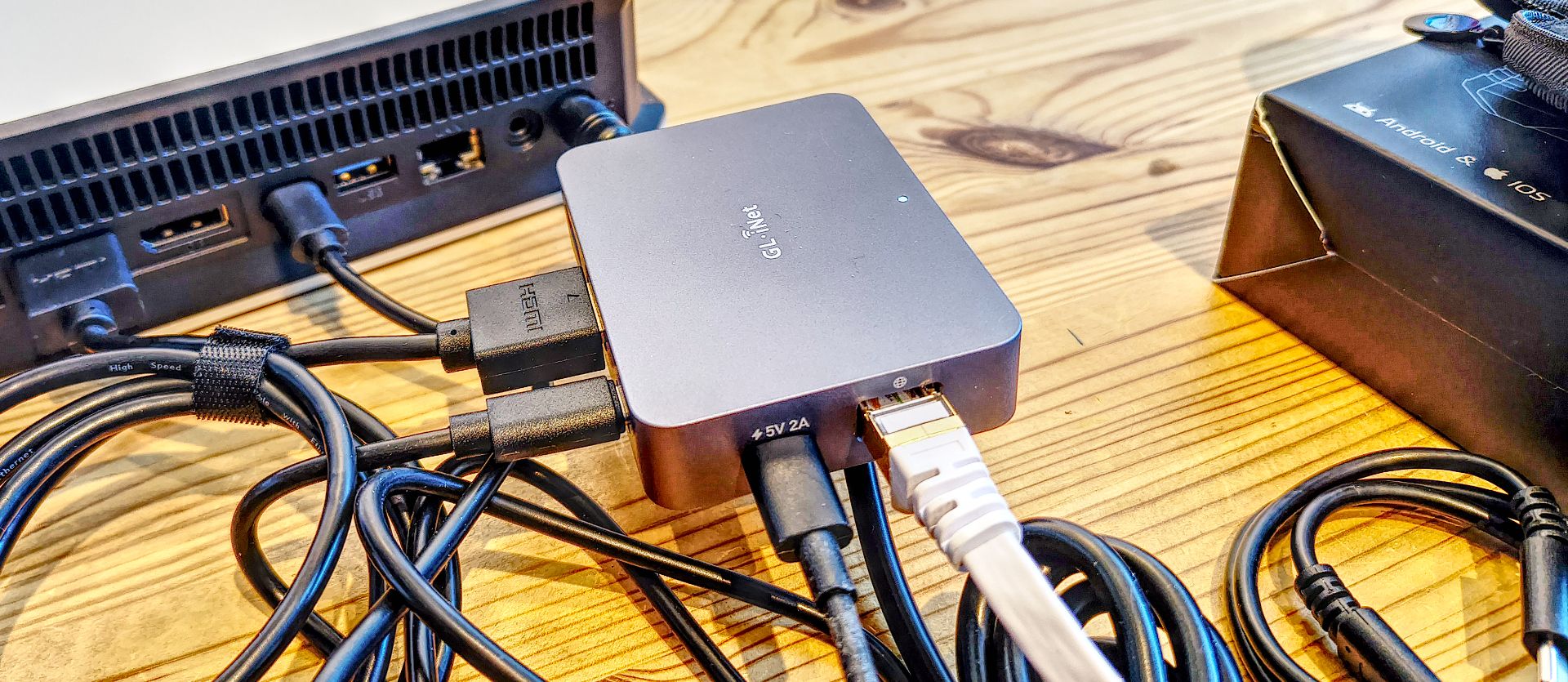
There is a fine irony with this device, in that GL.iNet made it remarkably small at just 8cm long and 60 cm wide, but the number of cable connections makes it seem much larger.
Thankfully, you don’t need to attach every cable, and I was able to get the review Comet operational with just four wires.
Obviously, the box needs power, and it accepts a 2A USB-C input, the sort of power that modern phone chargers output.
One slight curiosity is that the GL-iNet website states that you should only use the PSU provided, even though no PSU is actually included. Despite that confused messaging, I found it worked with a phone charger with no problems. Maybe, if you have a PC that supports the charge-while-off feature on one of its ports, you could power it from the host system.
The obvious weaknesses of this design are that it doesn’t have through-HDMI or through-LAN capability. The lack of a through HDMI solution means that if the host system has only a single HDMI port, it must be unplugged and reconnected to a local monitor to use it locally.
If the host has dual video outputs, then that’s not an issue. But what GL.iNet needs to consider is a USB-C connected version where the video comes over that connection, along with keyboard, mouse and LAN port, making deploying that model even simpler.

The Ethernet port is less of an issue, but it does require two network lines to operate both the host system and the Comet. A cheap five-port 1GbE Switch would solve that issue if only a single line is available.
To make this solution work locally, only the Comet’s IP address is required. However, those wanting to connect from another network, on the other side of the world, will need to use a Cloud service. Unlike some similar products, there are no ongoing costs for Cloud connections, irrespective of use or the number of Comets you use.
What I didn’t try with my Comet was the ATX card or the Fingerbot, as neither of these was supplied for this review. From what I understand, the ATX card is designed for server or PC installation, where it connects between the power and reset buttons and the motherboard, so you can press those buttons remotely. And, the port on the Comet marked USB 2.0 is designed to connect to the external backplane plate of the ATX card to square that circle.
As we’ll get into in the user experience section, the Achilles heel of any remote KVM technology is finding a reliable way to power a system back up from either a shutdown or hibernation. If you have a system that wakes from USB input (keyboard or mouse) or can be woken via Wake-on-LAN, you should be able to deploy the Comet successfully.

Design score: 4.5/5
GL.iNet Comet: In use
- Windows and Mac app
- Slow virtual media
- Security options
- Needs a fall-back plan
As I mentioned previously, it is possible to have direct access to the system on the same network by knowing its IP address and having a login to that system. Those wanting to control a system from farther away need to register for a GL.iNet account and use the web portal to select the target device.
I used the Windows application, which lists all the registered Comets and provides more control over the connection once it’s established.
When you first connect, the system will be presented as being in its typical screen resolution, and the speaker and microphone will be disabled. But the settings control of the app allows these to be enabled, which might prove to be highly useful for someone trying to fix an issue with the help of someone standing next to the computer.
One mild confusion I had was that by default, there are two mouse cursors, one on the remote system and another on my viewing PC. The remote cursor follows my local one around with a tiny delay, which is odd to see. However, I soon discovered you can disable this by toggling ‘Show Local Cursor’ and have only the local mouse pointer.
Using the settings sidebar, you can set alternative resolutions, orientations, the quality of the graphics, and choose between WebRTC H.264 or Direct H.264. On a local LAN, I didn’t notice any significant difference in high quality. The LAN port on the Comet is 1GbE, but for those connecting from another site over the Internet, the broadband performance could be the limiting factor to the quality and lag levels you might experience.
One of the classic limitations of LAN KVMs is that if you press Ctrl-Alt-Delete, the local computer will react, not the remote system. The app provides a clever way around that by having shortcuts for that and a few other special key sequences, and you can create your own.
You can also cut and paste to the remote system, send a Wake On LAN command and open a BASH terminal to the Comet, which, if you hadn’t guessed, runs Linux. And, you can SSH into it.
For those interested, the source code for this device is available in a GitHub repository, and it’s based on PiKVM but with a newly created GUI by GL.iNet.
Where I was less impressed was with the Virtual Media functionality, a mechanism that GL.iNet put in the Comet that allows bootable images to be uploaded and mounted so the host system can boot off that virtual drive.
There are two issues with this, the first of which is how slow it is to upload images to the flash memory on the Comet. And the speed of that memory isn’t the only issue, as it only offers a total capacity of 5.73 GB. That’s barely enough for a Windows 11 distro, if you are prepared to wait long enough to load it on there. What this device needed was a USB 3.0 port to connect an external drive to and then mount it.

Security wasn’t an afterthought here, and it impressed me that when you initially set the Comet up, it doesn’t have a silly admin/admin default. You must set a password, and you will need this and that of the remote system to get to its desktop.
For those who are more security-minded, 2FA can be activated, and there is also now the option for Tailscale, a VPN solution built on Wireguard. This should be reasonably secure if you have the proper protocols in place for when those with passwords leave and regular changes are made every few months.
What I really liked about this hardware was that when it links to a host system that’s booting, the keyboard becomes active early enough to get into the BIOS, enabling all manner of changes to be made.
The only snags I ran into were getting the system to reboot after a full shutdown, since the system I picked to use for testing appeared to ignore wake-on-LAN magic packets on occasion.
Without the ATX card, or on a system that couldn’t use that or the Fingerbot, the best solution would probably be to set the BIOS to start on power loss and use a smart socket to toggle the power. And, even if WOL or hibernation work as intended, that might be a good backup plan if you can’t get the system to wake when required.
Overall, with the exception of the Virtual Media aspect, the Comet works exceptionally well, and is certainly fit for purpose.

GL.iNet Comet: Final verdict
There are only two valid reasons not to buy this excellent solution, and one of those is the PoE version also sold by GL-iNet. The other is the third incarnation of this concept, currently being promoted on Kickstarter —the Comet Pro —which bears an uncanny resemblance to the JetKVM, with its front-facing display. That hardware can be obtained for $129.99 via Kickstarter, suggesting it will cost more when sold through standard retail channels.
Before the Comet launched, the JetKVM held sway over the sub-$100 remote KVM market, but since then, tariffs have increased the device’s cost in America and reduced its availability.
For that same market, the Comet is available and competitively priced, and does the job that many IT departments need.
I’d probably recommend the PoE version for those who use PoE, and I’ll be curious to see what extra the Pro model offers once it’s available in retail.
Should I buy a GL.iNet Comet?
|
Attributes |
Notes |
Rating |
|---|---|---|
|
Value |
One of the cheaper remote KVMs available |
4/5 |
|
Design |
Small device, but lots of cables, and you need a 5V power adapter |
4.5/5 |
|
In Use |
Works with any system, and you can even enter the BIOS |
4/5 |
|
Overall |
Does what IT people want with a few minor caveats |
4.5/5 |
Buy it if…
Don’t buy it if…
For more connectivity solutions, we’ve reviewed the best business routers
